

George Brown Polytechnic is located on the traditional territory of the Mississaugas of the Credit First Nation and other Indigenous peoples who have lived here over time. We are grateful to share this land as treaty people who learn, work and live in the community with each other.
Electromechanical Engineering Technician
(T146)
Program Details
- Program Code: T146
- Credential: Ontario College Diploma
- Duration: 2 years (4 semesters)
- Method of Study: Full-time
- Starting Months: January, September
- Domestic Tuition: $4,366.00 *
- International Tuition: $17,915.00 **
Program Availability
| Semester | Domestic | International |
|---|---|---|
| Fall 2023 | Closed | Closed |
| Winter 2024 | Closed | Closed |
| Spring 2024 | Not Available | Not Available |
- Work-Integrated Learning:
Available
- PGWP Eligible: No
- CIP Code: N/A
Program Description
Program Overview
*Domestic students only - see page for details.
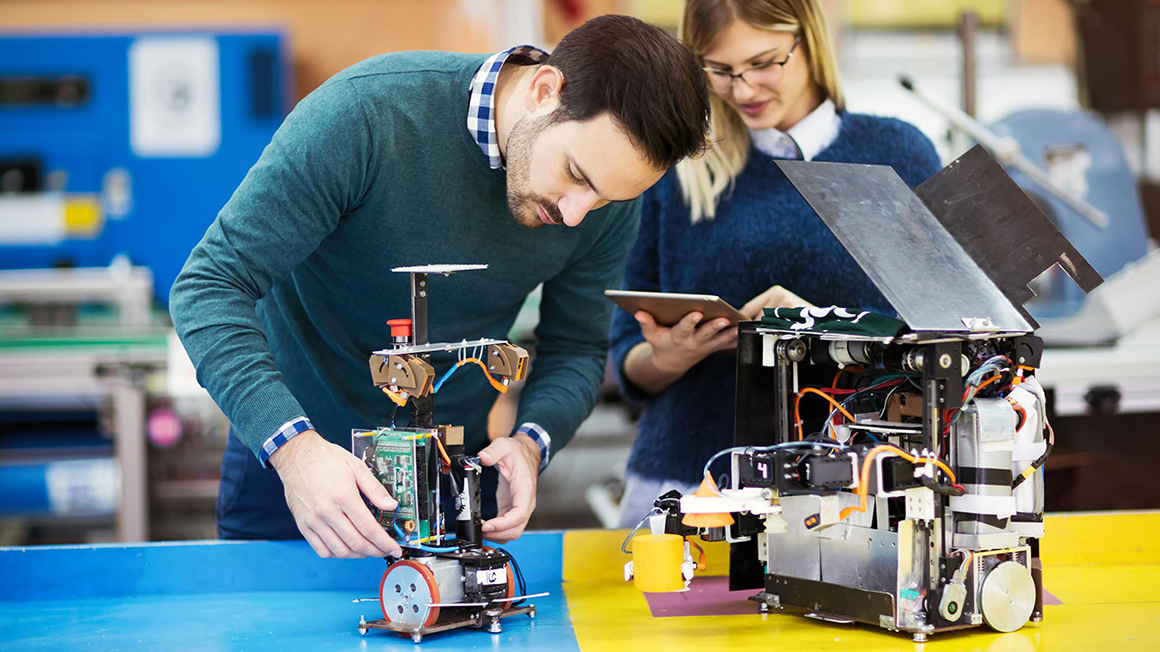
This Electromechanical Engineering program will prepare you for the rapidly changing demands of the North American industrial environment. Today’s companies require employees with multidisciplinary expertise that combines electrical, mechanical and controls engineering skills, along with the installation, maintenance and operation of increasingly sophisticated and automated equipment.
Full Description
Robotics, controls and process automation are cornerstones of modern production facilities and automated systems. Our multidisciplined and hands-on approach to learning culminates in a capstone project in which students design and produce a complex, integrated, fully functional electromechanical system by applying their accumulated theoretical and practical knowledge.
Students complement their technical skills with a focus on the soft skills needed to establish a successful career and add value to any team. Students will learn from faculty who are experienced in both the workplace and the teaching environment.
The industry-relevant curriculum is delivered through hands-on learning in the college’s machine shops, electrical and industrial automation laboratories, process controls and robotics facilities, to ensure that graduates can move quickly and directly into the industry.
Note: If you enrol in the program in January, you are required to complete semester 2 in the summer (May to August) of the same year to continue into semester 3 in the fall.
Career & Postgraduate Study Opportunities
Your Career
As technology continues to evolve at an unprecedented pace, graduates will be in high demand for their cross-disciplinary skills in all types of environments, including:
- automation and process control
- manufacturing and production
- assembly and packaging
- building and maintenance of automated systems
- power generation and transportation
- systems integration
- technical sales
- quality control and other related fields
Some of the college’s industry partners, who have led the development of this program, come from sectors as diverse as automotive manufacturing, tunnelling and drilling, consumer packaging (including canning, bottling and imaging), food and beverage production, urban transit, power generation, and industrial equipment production and maintenance.
Alumni Impact
We are immensely proud of the contributions of our alumni in Toronto and around the globe.
From Michelin-starred restaurants to major construction, entertainment, community and financial organizations, our graduates are truly making an impact across a range of industries.
Courses
Semester 1
| Code | Course Name |
|---|---|
| COMM2025 | Communicating with Impact |
| EMNG1001 | Circuit Analysis |
| GSSC1027 | Personal Finance |
| MATH1160 | Mathematics for Engineering Technology 1 |
| MENG1093 | Blueprint Reading & Metrology |
| MENG1094 | Machining Fundamentals |
Semester 2
| Code | Course Name |
|---|---|
| EMNG1012 | Introduction to Mechanical Cad |
| EMNG1013 | Electronic Devices |
| EMNG1015 | Motors and Controls |
| EMNG1016 | Electro-Pneumatics |
| MATH1171 | Mathematics for Engineering Technology 2 |
| GNED | General Elective |
Semester 3
| Code | Course Name |
|---|---|
| EMNG2001 | Plc Systems 1 |
| EMNG2004 | Digital Electronics |
| EMNG2006 | Operations Management and Quality Control |
| EMNG2008 | Electrical Cad |
| EMNG2020 | Instrumentation 1 |
| EMNG2021 | Automation Software Development |
| GNED | General Elective |
Semester 4
| Code | Course Name |
|---|---|
| EMNG2015 | Applied Project |
| EMNG2023 | Design & Prototyping |
| EMNG2031 | Plc Systems 2 |
| EMNG2034 | Embedded Systems & Interfacing |
| EMNG2040 | Workplace Preparedness & Technical Writing |
| EMNG2041 | Robotics |
Course Outline URL
Program Learning Outcomes
The graduate has reliably demonstrated the ability to:
- Fabricate and build electrical, electronic and mechanical components and assemblies in accordance with operating standards, job requirements and specifications.
- Interpret and produce electrical, electronic and mechanical drawings and other related technical documents and graphics for a variety of stakeholders in compliance with industry standards.
- Select and use a variety of troubleshooting techniques and equipment to assess, maintain and repair electromechanical circuits, equipment, processes, systems and subsystems.
- Maintain and repair electrical, electronic and mechanical components, equipment and systems to ensure that they function according to specifications and to optimize production.
- Support the design and production of mechanical components by assisting in the specification of manufacturing materials and processes.
- Apply, analyze, build, install, commission and troubleshoot a variety of mechanical, electrical and electronic control systems, logic and digital circuits, passive AC and DC circuits, and active circuits.
- Install and troubleshoot basic computer hardware and programming to support the electromechanical engineering environment.
- Maintain and troubleshoot automated equipment including robotic systems.
- Establish and maintain inventory, records, and documentation systems to meet organizational and industry standards and requirements
- Select and purchase electromechanical equipment, components and systems that fulfill job requirements and functional specifications.
- Assist in applying quality control and quality assurance program procedures to meet organizational standards and requirements.
- Work in compliance with relevant industry standards, laws and regulations, codes, policies and procedures.
- Develop strategies for ongoing personal and professional development to enhance work performance and to remain current in the field and responsive to emergent technologies and national and international standards.
- Contribute as an individual and a member of an electromechanical engineering team to the effective completion of tasks and projects.
- Support project management activities such as planning, implementation and evaluation of projects and monitoring of resources, timelines and expenditures as required.
Tuition & Fees
Domestic Tuition
$4,366.00 *
International Tuition
$17,915.00 **
Additional Costs
* Amounts listed are the total of tuition, materials, student service and ancillary fees for the first two semesters of programs starting in Fall 2022. Fees are subject to change for programs starting in Fall 2023 and at later dates.
** Amounts listed are the total of tuition, materials, student service and ancillary fees for the first two semesters of programs starting in Fall 2023. Fees are subject to change for programs starting in Fall 2024 and at later dates.
Students are responsible for purchasing CSA standard safety shoes for their protection when working in the laboratories.
CSA safety glasses are provided, but students who wish to use prescription safety glasses will be responsible for purchasing those separately.
International Students
Visit the International Fees and Related Costs page for more information.
International Students
Visit the International Fees and Related Costs page for more information.
Financial Assistance
This program is approved for OSAP funding, provided the applicant meets OSAP eligibility criteria.
Each year we award over $2 million dollars in scholarships, awards and bursaries to first-year students. Check out our financial aid webpages for ways to pay for college and the full list of available scholarships, awards and bursaries.
Admission Requirements
Applicants are selected on the basis of their academic achievement, including the required courses, and any other selection criteria outlined below.
- Ontario Secondary School Diploma or equivalent**
- grade 12 English (C or U)
- grade 11 Math (M or U) or grade 12 (C or U)
** Mature student status (19 years of age or older and no OSSD)
Mature students may take the Admissions Assessment for English and math, OR may consider upgrading to achieve the credit(s) needed in English and math.
Please note that George Brown is committed to ensuring that applicants will succeed in their program of choice and meeting the minimum requirements does not guarantee admission to the program. Applicants may be required to have grades higher than the minimum requirements stated.
International Students
Visit the International Admissions page for more information regarding country specific admission requirements.
Course exemptions
College or university credits may qualify you for course exemptions. Please visit Transfer Guide for more information.
International Students
Visit the International Admissions page for more information regarding country specific admission requirements.
How to Apply
Domestic students should apply through Ontario Colleges.
International Students
Visit the How to Apply page for more information on how and when to apply.
International students should apply through the George Brown College Online Application System.
International Students
Visit the How to Apply page for more information on how and when to apply.
International students should apply through the George Brown Polytechnic Online Application System.
Contact Us
School of Mechanical Engineering Technologies
Phone: 416-415-5000, ext. 4365
Email: engineeringtech@georgebrown.ca
Our office hours are 8 a.m. – 4 p.m., room D305
For more information about George Brown College, you may also call the Contact Centre at 416-415-2000 or long distance 1-800-265-2002.
International Students
Contact one of our international recruitment representatives specializing by country of origin by either booking a virtual meeting or submitting an inquiry. For more information visit the International Contact Us page
International Students
Contact one of our international recruitment representatives specializing by country of origin by either booking a virtual meeting or submitting an inquiry. For more information visit the International Contact Us page
Visit Our Campus
Do you have questions about this program or your career options? Join us for an on-campus information session. You'll have the opportunity to meet our friendly instructors and staff, ask questions and experience what it's like to be in a George Brown College classroom.
Program Description
Program Overview
*Domestic students only - see page for details.
This Electromechanical Engineering program will prepare you for the rapidly changing demands of the North American industrial environment. Today’s companies require employees with multidisciplinary expertise that combines electrical, mechanical and controls engineering skills, along with the installation, maintenance and operation of increasingly sophisticated and automated equipment.
Full Description
Robotics, controls and process automation are cornerstones of modern production facilities and automated systems. Our multidisciplined and hands-on approach to learning culminates in a capstone project in which students design and produce a complex, integrated, fully functional electromechanical system by applying their accumulated theoretical and practical knowledge.
Students complement their technical skills with a focus on the soft skills needed to establish a successful career and add value to any team. Students will learn from faculty who are experienced in both the workplace and the teaching environment.
The industry-relevant curriculum is delivered through hands-on learning in the college’s machine shops, electrical and industrial automation laboratories, process controls and robotics facilities, to ensure that graduates can move quickly and directly into the industry.
Note: If you enrol in the program in January, you are required to complete semester 2 in the summer (May to August) of the same year to continue into semester 3 in the fall.
Career & Postgraduate Study Opportunities
Your Career
As technology continues to evolve at an unprecedented pace, graduates will be in high demand for their cross-disciplinary skills in all types of environments, including:
- automation and process control
- manufacturing and production
- assembly and packaging
- building and maintenance of automated systems
- power generation and transportation
- systems integration
- technical sales
- quality control and other related fields
Some of the college’s industry partners, who have led the development of this program, come from sectors as diverse as automotive manufacturing, tunnelling and drilling, consumer packaging (including canning, bottling and imaging), food and beverage production, urban transit, power generation, and industrial equipment production and maintenance.
Alumni Impact
We are immensely proud of the contributions of our alumni in Toronto and around the globe.
From Michelin-starred restaurants to major construction, entertainment, community and financial organizations, our graduates are truly making an impact across a range of industries.
Courses
Semester 1
| Code | Course Name |
|---|---|
| COMM2025 | Communicating with Impact |
| EMNG1001 | Circuit Analysis |
| GSSC1027 | Personal Finance |
| MATH1160 | Mathematics for Engineering Technology 1 |
| MENG1093 | Blueprint Reading & Metrology |
| MENG1094 | Machining Fundamentals |
Semester 2
| Code | Course Name |
|---|---|
| EMNG1012 | Introduction to Mechanical Cad |
| EMNG1013 | Electronic Devices |
| EMNG1015 | Motors and Controls |
| EMNG1016 | Electro-Pneumatics |
| MATH1171 | Mathematics for Engineering Technology 2 |
| GNED | General Elective |
Semester 3
| Code | Course Name |
|---|---|
| EMNG2001 | Plc Systems 1 |
| EMNG2004 | Digital Electronics |
| EMNG2006 | Operations Management and Quality Control |
| EMNG2008 | Electrical Cad |
| EMNG2020 | Instrumentation 1 |
| EMNG2021 | Automation Software Development |
| GNED | General Elective |
Semester 4
| Code | Course Name |
|---|---|
| EMNG2015 | Applied Project |
| EMNG2023 | Design & Prototyping |
| EMNG2031 | Plc Systems 2 |
| EMNG2034 | Embedded Systems & Interfacing |
| EMNG2040 | Workplace Preparedness & Technical Writing |
| EMNG2041 | Robotics |
Course Outline URL
Tuition & Fees
Domestic Tuition
$4,366.00 *
International Tuition
$17,915.00 **
Additional Costs
* Amounts listed are the total of tuition, materials, student service and ancillary fees for the first two semesters of programs starting in Fall 2022. Fees are subject to change for programs starting in Fall 2023 and at later dates.
** Amounts listed are the total of tuition, materials, student service and ancillary fees for the first two semesters of programs starting in Fall 2023. Fees are subject to change for programs starting in Fall 2024 and at later dates.
Students are responsible for purchasing CSA standard safety shoes for their protection when working in the laboratories.
CSA safety glasses are provided, but students who wish to use prescription safety glasses will be responsible for purchasing those separately.
International Students
Visit the International Fees and Related Costs page for more information.
International Students
Visit the International Fees and Related Costs page for more information.
Financial Assistance
This program is approved for OSAP funding, provided the applicant meets OSAP eligibility criteria.
Each year we award over $2 million dollars in scholarships, awards and bursaries to first-year students. Check out our financial aid webpages for ways to pay for college and the full list of available scholarships, awards and bursaries.
Admission Requirements
Applicants are selected on the basis of their academic achievement, including the required courses, and any other selection criteria outlined below.
- Ontario Secondary School Diploma or equivalent**
- grade 12 English (C or U)
- grade 11 Math (M or U) or grade 12 (C or U)
** Mature student status (19 years of age or older and no OSSD)
Mature students may take the Admissions Assessment for English and math, OR may consider upgrading to achieve the credit(s) needed in English and math.
Please note that George Brown is committed to ensuring that applicants will succeed in their program of choice and meeting the minimum requirements does not guarantee admission to the program. Applicants may be required to have grades higher than the minimum requirements stated.
International Students
Visit the International Admissions page for more information regarding country specific admission requirements.
Course exemptions
College or university credits may qualify you for course exemptions. Please visit Transfer Guide for more information.
International Students
Visit the International Admissions page for more information regarding country specific admission requirements.
How to Apply
Domestic students should apply through Ontario Colleges.
International Students
Visit the How to Apply page for more information on how and when to apply.
International students should apply through the George Brown College Online Application System.
International Students
Visit the How to Apply page for more information on how and when to apply.
International students should apply through the George Brown Polytechnic Online Application System.
Program Learning Outcomes
The graduate has reliably demonstrated the ability to:
- Fabricate and build electrical, electronic and mechanical components and assemblies in accordance with operating standards, job requirements and specifications.
- Interpret and produce electrical, electronic and mechanical drawings and other related technical documents and graphics for a variety of stakeholders in compliance with industry standards.
- Select and use a variety of troubleshooting techniques and equipment to assess, maintain and repair electromechanical circuits, equipment, processes, systems and subsystems.
- Maintain and repair electrical, electronic and mechanical components, equipment and systems to ensure that they function according to specifications and to optimize production.
- Support the design and production of mechanical components by assisting in the specification of manufacturing materials and processes.
- Apply, analyze, build, install, commission and troubleshoot a variety of mechanical, electrical and electronic control systems, logic and digital circuits, passive AC and DC circuits, and active circuits.
- Install and troubleshoot basic computer hardware and programming to support the electromechanical engineering environment.
- Maintain and troubleshoot automated equipment including robotic systems.
- Establish and maintain inventory, records, and documentation systems to meet organizational and industry standards and requirements
- Select and purchase electromechanical equipment, components and systems that fulfill job requirements and functional specifications.
- Assist in applying quality control and quality assurance program procedures to meet organizational standards and requirements.
- Work in compliance with relevant industry standards, laws and regulations, codes, policies and procedures.
- Develop strategies for ongoing personal and professional development to enhance work performance and to remain current in the field and responsive to emergent technologies and national and international standards.
- Contribute as an individual and a member of an electromechanical engineering team to the effective completion of tasks and projects.
- Support project management activities such as planning, implementation and evaluation of projects and monitoring of resources, timelines and expenditures as required.
Contact Us
School of Mechanical Engineering Technologies
Phone: 416-415-5000, ext. 4365
Email: engineeringtech@georgebrown.ca
Our office hours are 8 a.m. – 4 p.m., room D305
For more information about George Brown College, you may also call the Contact Centre at 416-415-2000 or long distance 1-800-265-2002.
International Students
Contact one of our international recruitment representatives specializing by country of origin by either booking a virtual meeting or submitting an inquiry. For more information visit the International Contact Us page
International Students
Contact one of our international recruitment representatives specializing by country of origin by either booking a virtual meeting or submitting an inquiry. For more information visit the International Contact Us page
Visit Our Campus
Do you have questions about this program or your career options? Join us for an on-campus information session. You'll have the opportunity to meet our friendly instructors and staff, ask questions and experience what it's like to be in a George Brown College classroom.

Visit Casa Loma Campus
Book campus tourVisit
Our Virtual Tour showcases the following areas:
- Campus Facilities
- Student Services
- Applied Learning Environments
- Labs & Classrooms
Electromechanical Engineering Technician
(T146)
Program Details
- Program Code: T146
- Credential: Ontario College Diploma
- Duration: 2 years (4 semesters)
- Method of Study: Full-time
- Starting Months: January, September
- Domestic Tuition: $4,382.00 *
- International Tuition: $17,331.00 **
Program Availability
| Semester | Domestic | International |
|---|---|---|
| Fall 2022 | Closed | Closed |
| Winter 2023 | Closed | Closed |
| Spring 2023 | Not Available | Not Available |
- Work-Integrated Learning:
Available
- PGWP Eligible: No
- CIP Code: N/A
Program Description
Program Overview
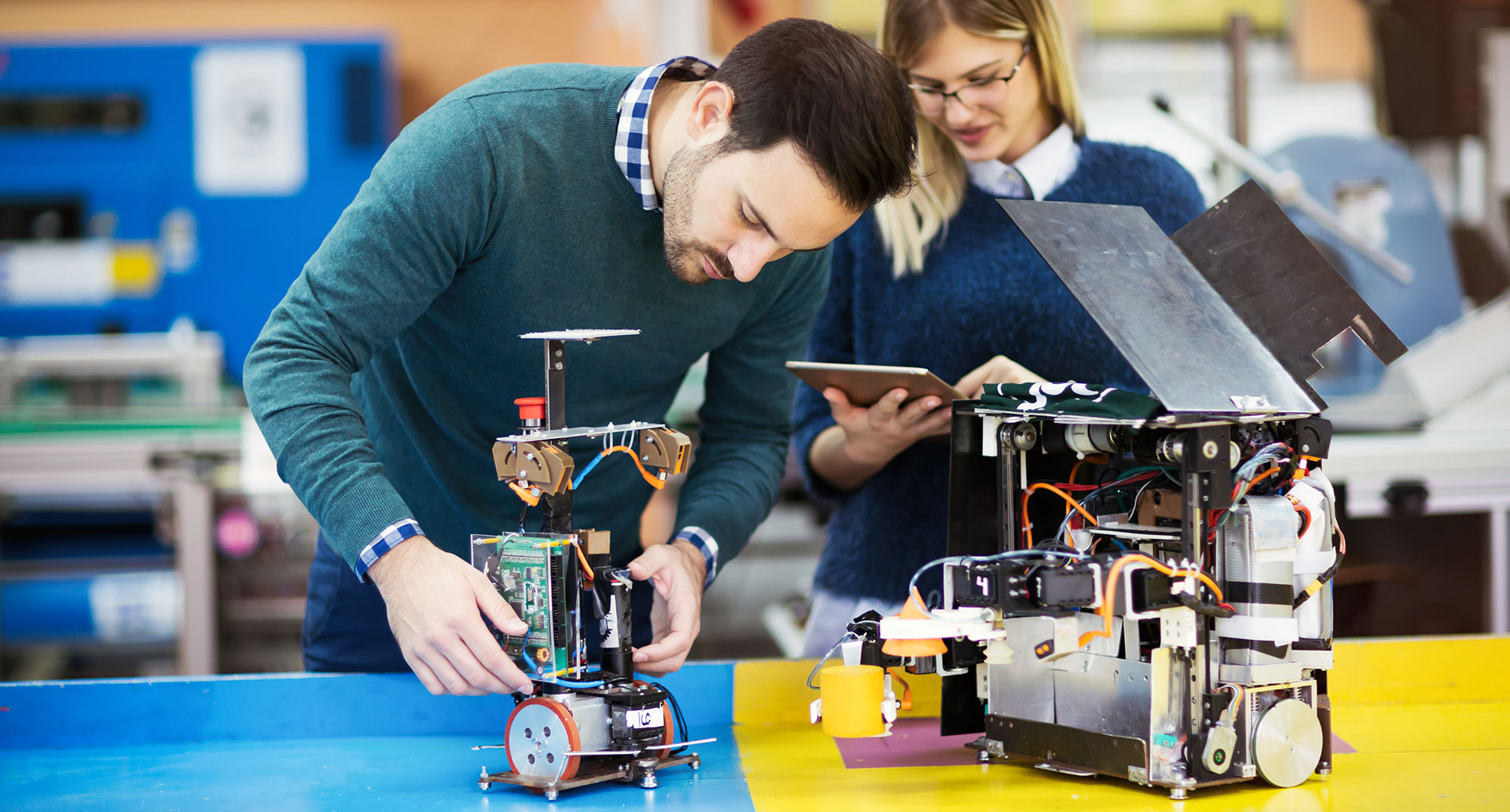
This Electromechanical Engineering program will prepare you for the rapidly changing demands of the North American industrial environment. Today’s companies require employees with multidisciplinary expertise that combines electrical, mechanical and controls engineering skills, along with the installation, maintenance and operation of increasingly sophisticated and automated equipment.
Full Description
Robotics, controls and process automation are cornerstones of modern production facilities and automated systems. Our multi-disciplined and hands-on approach to learning culminates in a capstone project in which students design and produce a complex, integrated, fully functional electromechanical system by applying their accumulated theoretical and practical knowledge.
Students complement their technical skills with a focus on the soft skills needed to establish a successful career and add value to any team. Students will learn from faculty who are experienced in both the workplace and the teaching environment.
The industry-relevant curriculum is delivered through hands-on learning in the college’s machine shops, electrical and industrial automation laboratories, process controls and robotics facilities, to ensure that graduates can move quickly and directly into the industry.
Note: If you enrol in the program in January you are required to complete semester 2 in the summer (May to August) of the same year in order to continue into semester 3 in the fall.
Career & Postgraduate Study Opportunities
Your Career
As technology continues to evolve at an unprecedented pace, graduates will be in high demand for their cross-disciplinary skills in all types of environments, including:
- automation and process control
- manufacturing and production
- assembly and packaging
- building and maintenance of automated systems
- power generation and transportation
- systems integration
- technical sales
- quality control and other related fields
Some of the college’s industry partners, who have led the development of this program, come from sectors as diverse as automotive manufacturing, tunnelling and drilling, consumer packaging (including canning, bottling and imaging), food and beverage production, urban transit, power generation, and industrial equipment production and maintenance.
Courses
Semester 1
| Code | Course Name |
|---|---|
| COMM2025 | Communicating with Impact |
| EMNG1001 | Circuit Analysis |
| GSSC1027 | Personal Finance |
| MATH1160 | Mathematics for Engineering Technology 1 |
| MENG1093 | Blueprint Reading & Metrology |
| MENG1094 | Machining Fundamentals |
Semester 2
| Code | Course Name |
|---|---|
| EMNG1012 | Introduction to Mechanical Cad |
| EMNG1013 | Electronic Devices |
| EMNG1015 | Motors and Controls |
| EMNG1016 | Electro-Pneumatics |
| MATH1171 | Mathematics for Engineering Technology 2 |
| GNED | General Elective |
Semester 3
| Code | Course Name |
|---|---|
| EMNG2001 | Plc Systems 1 |
| EMNG2004 | Digital Electronics |
| EMNG2006 | Operations Management and Quality Control |
| EMNG2008 | Electrical Cad |
| EMNG2020 | Instrumentation 1 |
| EMNG2021 | Automation Software Development |
| GNED | General Elective |
Semester 4
| Code | Course Name |
|---|---|
| EMNG2015 | Applied Project |
| EMNG2023 | Design & Prototyping |
| EMNG2031 | Plc Systems 2 |
| EMNG2034 | Embedded Systems & Interfacing |
| EMNG2040 | Workplace Preparedness & Technical Writing |
| EMNG2041 | Robotics |
Course Outline URL
Program Learning Outcomes
The graduate has reliably demonstrated the ability to:
- Fabricate and build electrical, electronic and mechanical components and assemblies in accordance with operating standards, job requirements and specifications.
- Interpret and produce electrical, electronic and mechanical drawings and other related technical documents and graphics for a variety of stakeholders in compliance with industry standards.
- Select and use a variety of troubleshooting techniques and equipment to assess, maintain and repair electromechanical circuits, equipment, processes, systems and subsystems.
- Maintain and repair electrical, electronic and mechanical components, equipment and systems to ensure that they function according to specifications and to optimize production.
- Support the design and production of mechanical components by assisting in the specification of manufacturing materials and processes.
- Apply, analyze, build, install, commission and troubleshoot a variety of mechanical, electrical and electronic control systems, logic and digital circuits, passive AC and DC circuits, and active circuits.
- Install and troubleshoot basic computer hardware and programming to support the electromechanical engineering environment.
- Maintain and troubleshoot automated equipment including robotic systems.
- Establish and maintain inventory, records, and documentation systems to meet organizational and industry standards and requirements
- Select and purchase electromechanical equipment, components and systems that fulfill job requirements and functional specifications.
- Assist in applying quality control and quality assurance program procedures to meet organizational standards and requirements.
- Work in compliance with relevant industry standards, laws and regulations, codes, policies and procedures.
- Develop strategies for ongoing personal and professional development to enhance work performance and to remain current in the field and responsive to emergent technologies and national and international standards.
- Contribute as an individual and a member of an electromechanical engineering team to the effective completion of tasks and projects.
- Support project management activities such as planning, implementation and evaluation of projects and monitoring of resources, timelines and expenditures as required.
Tuition & Fees
Domestic Tuition
$4,382.00 *
International Tuition
$17,331.00 **
Additional Costs
* Amounts listed are the total of tuition, materials, student service and ancillary fees for the first two semesters of programs starting in Fall 2021. Fees are subject to change for programs starting in Fall 2022 and at later dates.
** Amounts listed are the total of tuition, materials, student service and ancillary fees for the first two semesters of programs starting in Fall 2022. Fees are subject to change for programs starting in Fall 2023 and at later dates.
Students are responsible for purchasing CSA standard safety shoes for their protection when working in the laboratories.
CSA Safety glasses are provided, but students who wish to use prescription safety glasses will be responsible for purchasing those separately.
International Students
Visit the International Fees and Related Costs page for more information.
Financial Assistance
This program is approved for OSAP funding, provided the applicant meets OSAP eligibility criteria.
Admission Requirements
Applicants are selected on the basis of their academic achievement, including the required courses, and any other selection criteria outlined below.
- Ontario Secondary School Diploma or equivalent**
- Grade 12 English (C or U)
- Grade 11 Math (M or U) or Grade 12 (C or U)
** Mature student status (19 years of age or older and no OSSD)
Mature students may take the Admissions Assessment for English and math, OR may consider upgrading to achieve the credit(s) needed in English and math.
Please note that George Brown is committed to ensuring that applicants will succeed in their program of choice and meeting the minimum requirements does not guarantee admission to the program. Applicants may be required to have grades higher than the minimum requirements stated.
Course Exemptions
College or university credits may qualify you for course exemptions. Please visit Transfer Guide for more information.
International Students
Visit the International Admissions page for more information regarding country specific admission requirements.
How to Apply
Domestic students should apply through Ontario Colleges.
International Students
Visit the How to Apply page for more information on how and when to apply.
International students should apply through the George Brown Polytechnic Online Application System.
Contact Us
School of Mechanical Engineering Technologies
Phone: 416-415-5000, ext. 4365
Email: engineeringtech@georgebrown.ca
Our office hours are 8 a.m. – 4 p.m., room D305
For more information about George Brown College, you may also call the Contact Centre at 416-415-2000 (TTY 1-877-515-5559) or long distance 1-800-265-2002.
International Students
Contact one of our international recruitment representatives specializing by country of origin by either booking a virtual meeting or submitting an inquiry. For more information visit the International Contact Us page
Visit Our Campus
Do you have questions about this program or your career options? Join us for an on-campus Information Session. You'll have the opportunity to meet our friendly instructors and staff, ask questions and experience what it's like to be in a George Brown College classroom.
Program Description
Program Overview
This Electromechanical Engineering program will prepare you for the rapidly changing demands of the North American industrial environment. Today’s companies require employees with multidisciplinary expertise that combines electrical, mechanical and controls engineering skills, along with the installation, maintenance and operation of increasingly sophisticated and automated equipment.
Full Description
Robotics, controls and process automation are cornerstones of modern production facilities and automated systems. Our multi-disciplined and hands-on approach to learning culminates in a capstone project in which students design and produce a complex, integrated, fully functional electromechanical system by applying their accumulated theoretical and practical knowledge.
Students complement their technical skills with a focus on the soft skills needed to establish a successful career and add value to any team. Students will learn from faculty who are experienced in both the workplace and the teaching environment.
The industry-relevant curriculum is delivered through hands-on learning in the college’s machine shops, electrical and industrial automation laboratories, process controls and robotics facilities, to ensure that graduates can move quickly and directly into the industry.
Note: If you enrol in the program in January you are required to complete semester 2 in the summer (May to August) of the same year in order to continue into semester 3 in the fall.
Career & Postgraduate Study Opportunities
Your Career
As technology continues to evolve at an unprecedented pace, graduates will be in high demand for their cross-disciplinary skills in all types of environments, including:
- automation and process control
- manufacturing and production
- assembly and packaging
- building and maintenance of automated systems
- power generation and transportation
- systems integration
- technical sales
- quality control and other related fields
Some of the college’s industry partners, who have led the development of this program, come from sectors as diverse as automotive manufacturing, tunnelling and drilling, consumer packaging (including canning, bottling and imaging), food and beverage production, urban transit, power generation, and industrial equipment production and maintenance.
Courses
Semester 1
| Code | Course Name |
|---|---|
| COMM2025 | Communicating with Impact |
| EMNG1001 | Circuit Analysis |
| GSSC1027 | Personal Finance |
| MATH1160 | Mathematics for Engineering Technology 1 |
| MENG1093 | Blueprint Reading & Metrology |
| MENG1094 | Machining Fundamentals |
Semester 2
| Code | Course Name |
|---|---|
| EMNG1012 | Introduction to Mechanical Cad |
| EMNG1013 | Electronic Devices |
| EMNG1015 | Motors and Controls |
| EMNG1016 | Electro-Pneumatics |
| MATH1171 | Mathematics for Engineering Technology 2 |
| GNED | General Elective |
Semester 3
| Code | Course Name |
|---|---|
| EMNG2001 | Plc Systems 1 |
| EMNG2004 | Digital Electronics |
| EMNG2006 | Operations Management and Quality Control |
| EMNG2008 | Electrical Cad |
| EMNG2020 | Instrumentation 1 |
| EMNG2021 | Automation Software Development |
| GNED | General Elective |
Semester 4
| Code | Course Name |
|---|---|
| EMNG2015 | Applied Project |
| EMNG2023 | Design & Prototyping |
| EMNG2031 | Plc Systems 2 |
| EMNG2034 | Embedded Systems & Interfacing |
| EMNG2040 | Workplace Preparedness & Technical Writing |
| EMNG2041 | Robotics |
Course Outline URL
Tuition & Fees
Domestic Tuition
$4,382.00 *
International Tuition
$17,331.00 **
Additional Costs
* Amounts listed are the total of tuition, materials, student service and ancillary fees for the first two semesters of programs starting in Fall 2021. Fees are subject to change for programs starting in Fall 2022 and at later dates.
** Amounts listed are the total of tuition, materials, student service and ancillary fees for the first two semesters of programs starting in Fall 2022. Fees are subject to change for programs starting in Fall 2023 and at later dates.
Students are responsible for purchasing CSA standard safety shoes for their protection when working in the laboratories.
CSA Safety glasses are provided, but students who wish to use prescription safety glasses will be responsible for purchasing those separately.
International Students
Visit the International Fees and Related Costs page for more information.
Financial Assistance
This program is approved for OSAP funding, provided the applicant meets OSAP eligibility criteria.
Admission Requirements
Applicants are selected on the basis of their academic achievement, including the required courses, and any other selection criteria outlined below.
- Ontario Secondary School Diploma or equivalent**
- Grade 12 English (C or U)
- Grade 11 Math (M or U) or Grade 12 (C or U)
** Mature student status (19 years of age or older and no OSSD)
Mature students may take the Admissions Assessment for English and math, OR may consider upgrading to achieve the credit(s) needed in English and math.
Please note that George Brown is committed to ensuring that applicants will succeed in their program of choice and meeting the minimum requirements does not guarantee admission to the program. Applicants may be required to have grades higher than the minimum requirements stated.
Course Exemptions
College or university credits may qualify you for course exemptions. Please visit Transfer Guide for more information.
International Students
Visit the International Admissions page for more information regarding country specific admission requirements.
How to Apply
Domestic students should apply through Ontario Colleges.
International Students
Visit the How to Apply page for more information on how and when to apply.
International students should apply through the George Brown Polytechnic Online Application System.
Program Learning Outcomes
The graduate has reliably demonstrated the ability to:
- Fabricate and build electrical, electronic and mechanical components and assemblies in accordance with operating standards, job requirements and specifications.
- Interpret and produce electrical, electronic and mechanical drawings and other related technical documents and graphics for a variety of stakeholders in compliance with industry standards.
- Select and use a variety of troubleshooting techniques and equipment to assess, maintain and repair electromechanical circuits, equipment, processes, systems and subsystems.
- Maintain and repair electrical, electronic and mechanical components, equipment and systems to ensure that they function according to specifications and to optimize production.
- Support the design and production of mechanical components by assisting in the specification of manufacturing materials and processes.
- Apply, analyze, build, install, commission and troubleshoot a variety of mechanical, electrical and electronic control systems, logic and digital circuits, passive AC and DC circuits, and active circuits.
- Install and troubleshoot basic computer hardware and programming to support the electromechanical engineering environment.
- Maintain and troubleshoot automated equipment including robotic systems.
- Establish and maintain inventory, records, and documentation systems to meet organizational and industry standards and requirements
- Select and purchase electromechanical equipment, components and systems that fulfill job requirements and functional specifications.
- Assist in applying quality control and quality assurance program procedures to meet organizational standards and requirements.
- Work in compliance with relevant industry standards, laws and regulations, codes, policies and procedures.
- Develop strategies for ongoing personal and professional development to enhance work performance and to remain current in the field and responsive to emergent technologies and national and international standards.
- Contribute as an individual and a member of an electromechanical engineering team to the effective completion of tasks and projects.
- Support project management activities such as planning, implementation and evaluation of projects and monitoring of resources, timelines and expenditures as required.
Contact Us
School of Mechanical Engineering Technologies
Phone: 416-415-5000, ext. 4365
Email: engineeringtech@georgebrown.ca
Our office hours are 8 a.m. – 4 p.m., room D305
For more information about George Brown College, you may also call the Contact Centre at 416-415-2000 (TTY 1-877-515-5559) or long distance 1-800-265-2002.
International Students
Contact one of our international recruitment representatives specializing by country of origin by either booking a virtual meeting or submitting an inquiry. For more information visit the International Contact Us page
Visit Our Campus
Do you have questions about this program or your career options? Join us for an on-campus Information Session. You'll have the opportunity to meet our friendly instructors and staff, ask questions and experience what it's like to be in a George Brown College classroom.
Visit Casa Loma Campus
Book campus tourVisit
Our Virtual Tour showcases the following areas:
- Campus Facilities
- Student Services
- Applied Learning Environments
- Labs & Classrooms