

George Brown Polytechnic is located on the traditional territory of the Mississaugas of the Credit First Nation and other Indigenous peoples who have lived here over time. We are grateful to share this land as treaty people who learn, work and live in the community with each other.
Interaction Design
(G113)
Program Details
- Program Code: G113
- Credential: Ontario College Advanced Diploma
- Duration: 3 years (6 semesters)
- Method of Study: Full-time
- Starting Months: January, September
- Domestic Tuition: $8,895.00 *
- International Tuition: $22,435.00 **
Program Availability
| Semester | Domestic | International |
|---|---|---|
| Fall 2027 | Open | Open |
| Winter 2028 | Open | Opens Feb 3, 2027 |
| Spring 2028 | Not Available | Not Available |
- PGWP Eligible: Yes
- CIP Code: 11.0801
- Please note that field of study/CIP code is only one component of PGWP eligibility. Please consult the official IRCC PGWP eligibility webpage (opens in a new tab) for the most current and complete information.
Get answers to your questions
Book info sessionProgram Description
Program Overview
Join our cutting-edge three-year Interaction Design advanced diploma program and enter the dynamic world of experiential and interactive design. This interdisciplinary field blends design expertise in user experience, interface development, essential coding and artificial intelligence skills. You'll master the art of creating meaningful and engaging experiences across digital platforms such as mobile devices, websites, wearables and social media. Embark on a journey that combines creativity and technology to shape the future of digital and immersive interaction.
Full Description
Step into the ever-evolving world of interaction design with our innovative three-year Interaction Design (G113) advanced diploma program. As designers continuously re-imagine how we interact with technology, this program equips you to navigate and shape these changes, considering the technological, social, economic, cultural and psychological factors that influence our world.
You'll delve into a diverse range of cutting-edge topics, including artificial intelligence, mixed realities, immersive environments, usability, spatial relations and human factors. Our program emphasizes hands-on learning through usability testing, research, collaboration and real-world projects, ensuring that you gain invaluable practical experience. Join us to master the art of creating engaging and meaningful digital experiences and become a visionary in interaction design.
Your Field Education Options
Students have the opportunity to gain valuable real-world experience through INTR 3030 – Field Placement, an optional work-integrated learning (WIL) elective that offers a work placement with a real employer. Students who achieve a cumulative GPA of 3.5 or higher by the end of Semester 4 are eligible to access a job board featuring placements from employers recruited by the Field Education Office.
Please note:
International students are not eligible to enroll in INTR 3030 – Field Placement. As this is a non-mandatory WIL course, co-op work permits are not issued for participation in this elective. For inquiries regarding eligibility and work permits, please visit Permits and Visas – George Brown Polytechnic.
Learn more about Experiential Learning at the School of Design including how to apply, important dates, workflow, and PLAR eligibility.
General Computer Requirements
- Base model MacBook pro is recommended
- 16 gig of RAM
- 1Tb of hard drive space is recommended
Career & Postgraduate Study Opportunities
Alumni Impact
We are immensely proud of the contributions of our alumni in Toronto and around the globe.
From Michelin-starred restaurants to major construction, entertainment, community and financial organizations, our graduates are truly making an impact across a range of industries.
Courses
Semester 1
| Code | Course Name |
|---|---|
| COMM2000 | Communicating Across Contexts |
| INTR1001 | 2D Visualization |
| INTR1002 | Information Architecture 1 |
| INTR1003 | Visual Design |
| INTR1005 | Technical Drawing 1 |
| INTR1006 | Interactive Systems |
Semester 2
| Code | Course Name |
|---|---|
| INTR1007 | Design, Technology & Humans |
| INTR1011 | 3D Visualization 1 |
| INTR1012 | Information Architecture 2 |
| INTR1013 | Information Design |
| INTR1015 | Technical Drawing 2 |
| INTR2004 | Usability Testing |
Semester 3
| Code | Course Name |
|---|---|
| INTR1014 | Cognitive Ergonomics |
| INTR2001 | 3D Visualization 2 |
| INTR2002 | Interface Development 1 |
| INTR2003 | Communicating Design |
| INTR2005 | Branding and Marketing Strategies |
| GNED | General Elective |
Semester 4
| Code | Course Name |
|---|---|
| INTR2011 | 3D Visualization 3 |
| INTR2012 | Interface Development 2 |
| INTR2013 | Physical Interfaces |
| INTR2016 | Design Process & Management |
| INTR3004 | Ergonomics in Design |
| GNED | General Elective |
Semester 5
| Code | Course Name |
|---|---|
| INTR3002 | Device Development 1 |
| INTR3006 | Portfolio 1 |
| INTR3008 | Interactive Systems Project 1 |
| INTR3010 | Immersive Media 1 |
| INTR3013 | Human Computer Interaction |
| GNED | General Elective |
Semester 6
| Code | Course Name |
|---|---|
| INTR3012 | Device Development 2 |
| INTR3018 | Interactive Systems Project 2 |
| INTR3020 | Immersive Media 2 |
| INTR3024 | Interaction Design Studio Lab |
PROGRAM SPECIALIZATION (One Required)
| Code | Course Name |
|---|---|
| INTR3016 | Portfolio 2 |
| INTR3030 | Field Placement |
Course Outline URL
Program Learning Outcomes
The graduate demonstrates the ability to:
- Collaborate in a team environment with various stakeholders to design multi-disciplinary products and services.
- Apply the appropriate tools that allow for designing, building, visualizing and programming digital interactive experiences.
- Assess the requirements of a complex interactive media project.
- Plan the development and execution of an interaction design project in response to resource and budgetary requirements.
- Design a complex media project (interface, navigation, graphics, text treatment) using best practice design and development principles and applying conceptual and theoretical frameworks.
- Make interactive products, environments, systems and services using appropriate technologies, materials and manufacturing methods.
- Perform all work in compliance with regulations, legislation, security policies, industry standards and codes of ethics.
- Use research skills to assess and inform optimal digital user experience within interactive interfaces.
- Apply creative and innovative thinking techniques to manage change and solve design problems.
- Make recommendations based on human-computer interaction design guidelines to improve user experiences with interaction design.
- Design an interactive product or service that delivers a usable interactive experience.
- Contribute to a variety of interactive platforms and environments, incorporating the principles and elements of design.
- Create a design solution in accordance with strategies, recommendations and state-of-the art methodologies.
Tuition & Fees
Domestic Tuition
$8,895.00 *
International Tuition
$22,435.00 **
Additional Costs
*Amounts listed are the estimated total tuition, materials (non-refundable), student service and ancillary fees for the first two semesters of programs starting in Fall 2026. Fees are subject to change for programs starting in Fall 2027 and at later dates. This fee does not include books, E-text and other material, which are to be purchased by the student separately.
** Amounts listed are the estimated total of tuition, materials, student service and ancillary fees for the first two semesters of programs starting in Fall 2026. Fees are subject to change for programs starting in Fall 2027 and at later dates. This fee does not include books, E-text and other material, which are to be purchased by the student separately.
International Students
Visit the International Fees and Related Costs page for more information.
Financial Assistance
Each year we award over $2 million dollars in scholarships, awards and bursaries to first-year students. Check out our financial aid web pages for ways to pay for college and the full list of available scholarships, awards and bursaries.
This program is approved for OSAP funding, provided the applicant meets OSAP eligibility criteria.
Admission Requirements
Applicants are selected on the basis of their academic achievement, including the required courses, and any other selection criteria outlined below.
- Ontario Secondary School Diploma or equivalent**
- Grade 12 English (C or U)
** Mature Student Status (19 years of age or older and no OSSD)
Mature students may take the Admissions Assessment for English OR may consider upgrading to achieve the credit(s) needed in English.
Please note that George Brown is committed to ensuring that applicants will succeed in their program of choice and meeting the minimum requirements does not guarantee admission to the program. Applicants may be required to have grades higher than the minimum requirements stated.
Course Exemptions
College or university credits may qualify you for course exemptions. Please visit the Transfer Guide for more information.
International Students
Visit the International Admissions page for more information regarding country specific admission requirements.
How to Apply
Domestic students should apply through Ontario Colleges.
International Students
Visit the How to Apply page for more information on how and when to apply.
International students should apply through the George Brown Polytechnic Online Application System.
Contact Us
School of Design
Phone: 416-415-5000, ext. 3129
Email: design@georgebrown.ca
Program Co-ordinators:
Nastaran Dadashi at Nastaran.Dadashi@georgebrown.ca
Toni Allen at Toni.Allen@georgebrown.ca
International Students
Contact one of our international recruitment representatives specializing by country of origin by either booking a virtual meeting or submitting an inquiry. For more information visit the International Contact Us page
Visit Our Campus
This program is part of our School of Design, located at our Waterfront Campus, at 3 Lower Jarvis St., Toronto, Ontario, Canada.
School of Design Building
The School of Design resides in a new 103,000-square-foot facility in the Daniels Waterfront – City of the Arts development. This state-of-the-art building supports academic programs and industry projects with features such as:
- virtual and augmented reality lab
- usability and testing lab
- Future Ways of Living lab
- peer tutor lab
- digital sandbox
- incubators
- prototyping and workshop spaces
- design and innovation showcase spaces
Come and have your questions answered, learn about the program content and career options, meet your friendly professors and staff and experience what it is like to be in a George Brown Polytechnic classroom at one of our information sessions. You can also book a campus tour or explore our virtual tour.
Program Description
Program Overview
Join our cutting-edge three-year Interaction Design advanced diploma program and enter the dynamic world of experiential and interactive design. This interdisciplinary field blends design expertise in user experience, interface development, essential coding and artificial intelligence skills. You'll master the art of creating meaningful and engaging experiences across digital platforms such as mobile devices, websites, wearables and social media. Embark on a journey that combines creativity and technology to shape the future of digital and immersive interaction.
Full Description
Step into the ever-evolving world of interaction design with our innovative three-year Interaction Design (G113) advanced diploma program. As designers continuously re-imagine how we interact with technology, this program equips you to navigate and shape these changes, considering the technological, social, economic, cultural and psychological factors that influence our world.
You'll delve into a diverse range of cutting-edge topics, including artificial intelligence, mixed realities, immersive environments, usability, spatial relations and human factors. Our program emphasizes hands-on learning through usability testing, research, collaboration and real-world projects, ensuring that you gain invaluable practical experience. Join us to master the art of creating engaging and meaningful digital experiences and become a visionary in interaction design.
Your Field Education Options
Students have the opportunity to gain valuable real-world experience through INTR 3030 – Field Placement, an optional work-integrated learning (WIL) elective that offers a work placement with a real employer. Students who achieve a cumulative GPA of 3.5 or higher by the end of Semester 4 are eligible to access a job board featuring placements from employers recruited by the Field Education Office.
Please note:
International students are not eligible to enroll in INTR 3030 – Field Placement. As this is a non-mandatory WIL course, co-op work permits are not issued for participation in this elective. For inquiries regarding eligibility and work permits, please visit Permits and Visas – George Brown Polytechnic.
Learn more about Experiential Learning at the School of Design including how to apply, important dates, workflow, and PLAR eligibility.
General Computer Requirements
- Base model MacBook pro is recommended
- 16 gig of RAM
- 1Tb of hard drive space is recommended
Career & Postgraduate Study Opportunities
Courses
Semester 1
| Code | Course Name |
|---|---|
| COMM2000 | Communicating Across Contexts |
| INTR1001 | 2D Visualization |
| INTR1002 | Information Architecture 1 |
| INTR1003 | Visual Design |
| INTR1005 | Technical Drawing 1 |
| INTR1006 | Interactive Systems |
Semester 2
| Code | Course Name |
|---|---|
| INTR1007 | Design, Technology & Humans |
| INTR1011 | 3D Visualization 1 |
| INTR1012 | Information Architecture 2 |
| INTR1013 | Information Design |
| INTR1015 | Technical Drawing 2 |
| INTR2004 | Usability Testing |
Semester 3
| Code | Course Name |
|---|---|
| INTR1014 | Cognitive Ergonomics |
| INTR2001 | 3D Visualization 2 |
| INTR2002 | Interface Development 1 |
| INTR2003 | Communicating Design |
| INTR2005 | Branding and Marketing Strategies |
| GNED | General Elective |
Semester 4
| Code | Course Name |
|---|---|
| INTR2011 | 3D Visualization 3 |
| INTR2012 | Interface Development 2 |
| INTR2013 | Physical Interfaces |
| INTR2016 | Design Process & Management |
| INTR3004 | Ergonomics in Design |
| GNED | General Elective |
Semester 5
| Code | Course Name |
|---|---|
| INTR3002 | Device Development 1 |
| INTR3006 | Portfolio 1 |
| INTR3008 | Interactive Systems Project 1 |
| INTR3010 | Immersive Media 1 |
| INTR3013 | Human Computer Interaction |
| GNED | General Elective |
Semester 6
| Code | Course Name |
|---|---|
| INTR3012 | Device Development 2 |
| INTR3018 | Interactive Systems Project 2 |
| INTR3020 | Immersive Media 2 |
| INTR3024 | Interaction Design Studio Lab |
PROGRAM SPECIALIZATION (One Required)
| Code | Course Name |
|---|---|
| INTR3016 | Portfolio 2 |
| INTR3030 | Field Placement |
Course Outline URL
Tuition & Fees
Domestic Tuition
$8,895.00 *
International Tuition
$22,435.00 **
Additional Costs
*Amounts listed are the estimated total tuition, materials (non-refundable), student service and ancillary fees for the first two semesters of programs starting in Fall 2026. Fees are subject to change for programs starting in Fall 2027 and at later dates. This fee does not include books, E-text and other material, which are to be purchased by the student separately.
** Amounts listed are the estimated total of tuition, materials, student service and ancillary fees for the first two semesters of programs starting in Fall 2026. Fees are subject to change for programs starting in Fall 2027 and at later dates. This fee does not include books, E-text and other material, which are to be purchased by the student separately.
International Students
Visit the International Fees and Related Costs page for more information.
Financial Assistance
Each year we award over $2 million dollars in scholarships, awards and bursaries to first-year students. Check out our financial aid web pages for ways to pay for college and the full list of available scholarships, awards and bursaries.
This program is approved for OSAP funding, provided the applicant meets OSAP eligibility criteria.
Admission Requirements
Applicants are selected on the basis of their academic achievement, including the required courses, and any other selection criteria outlined below.
- Ontario Secondary School Diploma or equivalent**
- Grade 12 English (C or U)
** Mature Student Status (19 years of age or older and no OSSD)
Mature students may take the Admissions Assessment for English OR may consider upgrading to achieve the credit(s) needed in English.
Please note that George Brown is committed to ensuring that applicants will succeed in their program of choice and meeting the minimum requirements does not guarantee admission to the program. Applicants may be required to have grades higher than the minimum requirements stated.
Course Exemptions
College or university credits may qualify you for course exemptions. Please visit the Transfer Guide for more information.
International Students
Visit the International Admissions page for more information regarding country specific admission requirements.
How to Apply
Domestic students should apply through Ontario Colleges.
International Students
Visit the How to Apply page for more information on how and when to apply.
International students should apply through the George Brown Polytechnic Online Application System.
Program Learning Outcomes
The graduate demonstrates the ability to:
- Collaborate in a team environment with various stakeholders to design multi-disciplinary products and services.
- Apply the appropriate tools that allow for designing, building, visualizing and programming digital interactive experiences.
- Assess the requirements of a complex interactive media project.
- Plan the development and execution of an interaction design project in response to resource and budgetary requirements.
- Design a complex media project (interface, navigation, graphics, text treatment) using best practice design and development principles and applying conceptual and theoretical frameworks.
- Make interactive products, environments, systems and services using appropriate technologies, materials and manufacturing methods.
- Perform all work in compliance with regulations, legislation, security policies, industry standards and codes of ethics.
- Use research skills to assess and inform optimal digital user experience within interactive interfaces.
- Apply creative and innovative thinking techniques to manage change and solve design problems.
- Make recommendations based on human-computer interaction design guidelines to improve user experiences with interaction design.
- Design an interactive product or service that delivers a usable interactive experience.
- Contribute to a variety of interactive platforms and environments, incorporating the principles and elements of design.
- Create a design solution in accordance with strategies, recommendations and state-of-the art methodologies.
Contact Us
School of Design
Phone: 416-415-5000, ext. 3129
Email: design@georgebrown.ca
Program Co-ordinators:
Nastaran Dadashi at Nastaran.Dadashi@georgebrown.ca
Toni Allen at Toni.Allen@georgebrown.ca
International Students
Contact one of our international recruitment representatives specializing by country of origin by either booking a virtual meeting or submitting an inquiry. For more information visit the International Contact Us page
Visit Our Campus
This program is part of our School of Design, located at our Waterfront Campus, at 3 Lower Jarvis St., Toronto, Ontario, Canada.
School of Design Building
The School of Design resides in a new 103,000-square-foot facility in the Daniels Waterfront – City of the Arts development. This state-of-the-art building supports academic programs and industry projects with features such as:
- virtual and augmented reality lab
- usability and testing lab
- Future Ways of Living lab
- peer tutor lab
- digital sandbox
- incubators
- prototyping and workshop spaces
- design and innovation showcase spaces
Come and have your questions answered, learn about the program content and career options, meet your friendly professors and staff and experience what it is like to be in a George Brown Polytechnic classroom at one of our information sessions. You can also book a campus tour or explore our virtual tour.

Visit Waterfront Campus
Book campus tourGet answers to your questions
Book info sessionVisit
Our Virtual Tour showcases the following areas:
- Campus Facilities
- Student Services
- Applied Learning Environments
- Labs & Classrooms
Interaction Design
(G113)
Program Details
- Program Code: G113
- Credential: Ontario College Advanced Diploma
- Duration: 3 years
- Method of Study: Full-time
- Starting Months: January, September
- Domestic Tuition: $8,648.00 *
- International Tuition: $22,300.00 **
- Fall 2026 Delivery: Semester 1, 3, 5: On Campus
- Winter 2027 Delivery: Semester 1, 2, 4, 6: On Campus
Program Availability
| Semester | Domestic | International |
|---|---|---|
| Fall 2026 | Closed | Closed |
| Winter 2027 | Open | Open |
| Spring 2027 | Not Available | Not Available |
- PGWP Eligible: Yes
- CIP Code: 11.0801
- Please note that field of study/CIP code is only one component of PGWP eligibility. Please consult the official IRCC PGWP eligibility webpage (opens in a new tab) for the most current and complete information.
Get answers to your questions
Book info sessionProgram Description
Program Overview
Join our cutting-edge three-year Interaction Design advanced diploma program and enter the dynamic world of experiential and interactive design. This interdisciplinary field blends design expertise in user experience, interface development, essential coding and artificial intelligence skills. You'll master the art of creating meaningful and engaging experiences across digital platforms such as mobile devices, websites, wearables and social media. Embark on a journey that combines creativity and technology to shape the future of digital and immersive interaction.
Full Description
Step into the ever-evolving world of interaction design with our innovative three-year Interaction Design advanced diploma program. As designers continuously re-imagine how we interact with technology, this program equips you to navigate and shape these changes, considering the technological, social, economic, cultural and psychological factors that influence our world.
You'll delve into a diverse range of cutting-edge topics, including artificial intelligence, mixed realities, immersive environments, usability, spatial relations and human factors. Our program emphasizes hands-on learning through usability testing, research, collaboration and real-world projects, ensuring that you gain invaluable practical experience. Join us to master the art of creating engaging and meaningful digital experiences and become a visionary in interaction design.
Your Field Education Options
Students have the opportunity to gain valuable real-world experience through INTR 3030 – Field Placement, an optional work-integrated learning (WIL) elective that offers a work placement with a real employer. Students who achieve a cumulative GPA of 3.5 or higher by the end of Semester 4 are eligible to access a job board featuring placements from employers recruited by the Field Education Office.
Please note:
International students are not eligible to enroll in INTR 3030 – Field Placement. As this is a non-mandatory WIL course, co-op work permits are not issued for participation in this elective. For inquiries regarding eligibility and work permits, please visit Permits and Visas – George Brown Polytechnic.
Learn more about Experiential Learning at the School of Design including how to apply, important dates, workflow, and PLAR eligibility.
General Computer Requirements
- Base model MacBook pro is recommended
- 16 gig of RAM
- 1Tb of hard drive space is recommended
Career & Postgraduate Study Opportunities
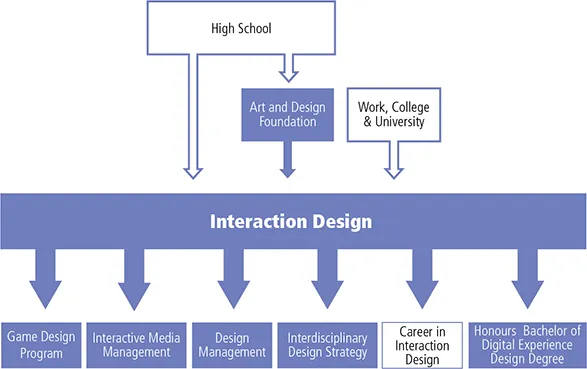
Educational Pathways
Alumni Impact
We are immensely proud of the contributions of our alumni in Toronto and around the globe.
From Michelin-starred restaurants to major construction, entertainment, community and financial organizations, our graduates are truly making an impact across a range of industries.
Courses
Semester 1
| Code | Course Name |
|---|---|
| COMM2000 | Communicating Across Contexts |
| INTR1001 | 2D Visualization |
| INTR1002 | Information Architecture 1 |
| INTR1003 | Visual Design |
| INTR1005 | Technical Drawing 1 |
| INTR1006 | Interactive Systems |
Semester 2
| Code | Course Name |
|---|---|
| INTR1007 | Design, Technology & Humans |
| INTR1011 | 3D Visualization 1 |
| INTR1012 | Information Architecture 2 |
| INTR1013 | Information Design |
| INTR1015 | Technical Drawing 2 |
| INTR2004 | Usability Testing |
Semester 3
| Code | Course Name |
|---|---|
| INTR1014 | Cognitive Ergonomics |
| INTR2001 | 3D Visualization 2 |
| INTR2002 | Interface Development 1 |
| INTR2003 | Communicating Design |
| INTR2005 | Branding and Marketing Strategies |
| GNED | General Elective |
Semester 4
| Code | Course Name |
|---|---|
| INTR2011 | 3D Visualization 3 |
| INTR2012 | Interface Development 2 |
| INTR2013 | Physical Interfaces |
| INTR2016 | Design Process & Management |
| INTR3004 | Ergonomics in Design |
| GNED | General Elective |
Semester 5
| Code | Course Name |
|---|---|
| INTR3002 | Device Development 1 |
| INTR3006 | Portfolio 1 |
| INTR3008 | Interactive Systems Project 1 |
| INTR3010 | Immersive Media 1 |
| INTR3013 | Human Computer Interaction |
| GNED | General Elective |
Semester 6
| Code | Course Name |
|---|---|
| INTR3012 | Device Development 2 |
| INTR3018 | Interactive Systems Project 2 |
| INTR3020 | Immersive Media 2 |
| INTR3024 | Interaction Design Studio Lab |
PROGRAM SPECIALIZATION (One Required)
| Code | Course Name |
|---|---|
| INTR3016 | Portfolio 2 |
| INTR3030 | Field Placement |
Course Outline URL
Program Learning Outcomes
The graduate demonstrates the ability to:
- Collaborate in a team environment with various stakeholders to design multi-disciplinary products and services.
- Apply the appropriate tools that allow for designing, building, visualizing and programming digital interactive experiences.
- Assess the requirements of a complex interactive media project.
- Plan the development and execution of an interaction design project in response to resource and budgetary requirements.
- Design a complex media project (interface, navigation, graphics, text treatment) using best practice design and development principles and applying conceptual and theoretical frameworks.
- Make interactive products, environments, systems and services using appropriate technologies, materials and manufacturing methods.
- Perform all work in compliance with regulations, legislation, security policies, industry standards and codes of ethics.
- Use research skills to assess and inform optimal digital user experience within interactive interfaces.
- Apply creative and innovative thinking techniques to manage change and solve design problems.
- Make recommendations based on human-computer interaction design guidelines to improve user experiences with interaction design.
- Design an interactive product or service that delivers a usable interactive experience.
- Contribute to a variety of interactive platforms and environments, incorporating the principles and elements of design.
- Create a design solution in accordance with strategies, recommendations and state-of-the art methodologies.
Tuition & Fees
Domestic Tuition
$8,648.00 *
International Tuition
$22,300.00 **
Additional Costs
*Amounts listed are the estimated total tuition, materials (non-refundable), student service and ancillary fees for the first two semesters of programs starting in Fall 2025. Fees are subject to change for programs starting in Fall 2026 and at later dates. This fee does not include books, which are to be purchased by the student separately.
** Amounts listed are the estimated total of tuition, materials, student service and ancillary fees for the first two semesters of programs starting in Fall 2026. Tuition fees are subject to board approval. Material, student service and ancillary fees are estimated based on prior years. All fees are subject to change without notice. This fee does not include books, which are to be purchased by the student separately.
International Students
Visit the International Fees and Related Costs page for more information.
Financial Assistance
Each year we award over $2 million dollars in scholarships, awards and bursaries to first-year students. Check out our financial aid web pages for ways to pay for college and the full list of available scholarships, awards and bursaries.
This program is approved for OSAP funding, provided the applicant meets OSAP eligibility criteria.
Admission Requirements
Applicants are selected on the basis of their academic achievement, including the required courses, and any other selection criteria outlined below.
- Ontario Secondary School Diploma or equivalent**
- Grade 12 English (C or U)
** Mature Student Status (19 years of age or older and no OSSD)
Mature students may take the Admissions Assessment for English OR may consider upgrading to achieve the credit(s) needed in English.
Please note that George Brown is committed to ensuring that applicants will succeed in their program of choice and meeting the minimum requirements does not guarantee admission to the program. Applicants may be required to have grades higher than the minimum requirements stated.
Course Exemptions
College or university credits may qualify you for course exemptions. Please visit the Transfer Guide for more information.
International Students
Visit the International Admissions page for more information regarding country specific admission requirements.
How to Apply
Domestic students should apply through Ontario Colleges.
International Students
Visit the How to Apply page for more information on how and when to apply.
International students should apply through the George Brown Polytechnic Online Application System.
Contact Us
School of Design
Phone: 416-415-5000, ext. 3129
Email: design@georgebrown.ca
Program Co-ordinators:
Nastaran Dadashi at Nastaran.Dadashi@georgebrown.ca
Toni Allen at Toni.Allen@georgebrown.ca
International Students
Contact one of our international recruitment representatives specializing by country of origin by either booking a virtual meeting or submitting an inquiry. For more information visit the International Contact Us page
Visit Our Campus
This program is part of our School of Design, located at our Waterfront Campus, at 3 Lower Jarvis St., Toronto, Ontario, Canada.
School of Design Building
The School of Design resides in a new 103,000-square-foot facility in the Daniels Waterfront – City of the Arts development. This state-of-the-art building supports academic programs and industry projects with features such as:
- virtual and augmented reality lab
- usability and testing lab
- Future Ways of Living lab
- peer tutor lab
- digital sandbox
- incubators
- prototyping and workshop spaces
- design and innovation showcase spaces
Come and have your questions answered, learn about the program content and career options, meet your friendly professors and staff and experience what it is like to be in a George Brown Polytechnic classroom at one of our information sessions. You can also book a campus tour or explore our virtual tour.
Program Description
Program Overview
Join our cutting-edge three-year Interaction Design advanced diploma program and enter the dynamic world of experiential and interactive design. This interdisciplinary field blends design expertise in user experience, interface development, essential coding and artificial intelligence skills. You'll master the art of creating meaningful and engaging experiences across digital platforms such as mobile devices, websites, wearables and social media. Embark on a journey that combines creativity and technology to shape the future of digital and immersive interaction.
Full Description
Step into the ever-evolving world of interaction design with our innovative three-year Interaction Design advanced diploma program. As designers continuously re-imagine how we interact with technology, this program equips you to navigate and shape these changes, considering the technological, social, economic, cultural and psychological factors that influence our world.
You'll delve into a diverse range of cutting-edge topics, including artificial intelligence, mixed realities, immersive environments, usability, spatial relations and human factors. Our program emphasizes hands-on learning through usability testing, research, collaboration and real-world projects, ensuring that you gain invaluable practical experience. Join us to master the art of creating engaging and meaningful digital experiences and become a visionary in interaction design.
Your Field Education Options
Students have the opportunity to gain valuable real-world experience through INTR 3030 – Field Placement, an optional work-integrated learning (WIL) elective that offers a work placement with a real employer. Students who achieve a cumulative GPA of 3.5 or higher by the end of Semester 4 are eligible to access a job board featuring placements from employers recruited by the Field Education Office.
Please note:
International students are not eligible to enroll in INTR 3030 – Field Placement. As this is a non-mandatory WIL course, co-op work permits are not issued for participation in this elective. For inquiries regarding eligibility and work permits, please visit Permits and Visas – George Brown Polytechnic.
Learn more about Experiential Learning at the School of Design including how to apply, important dates, workflow, and PLAR eligibility.
General Computer Requirements
- Base model MacBook pro is recommended
- 16 gig of RAM
- 1Tb of hard drive space is recommended
Career & Postgraduate Study Opportunities
Educational Pathways
Courses
Semester 1
| Code | Course Name |
|---|---|
| COMM2000 | Communicating Across Contexts |
| INTR1001 | 2D Visualization |
| INTR1002 | Information Architecture 1 |
| INTR1003 | Visual Design |
| INTR1005 | Technical Drawing 1 |
| INTR1006 | Interactive Systems |
Semester 2
| Code | Course Name |
|---|---|
| INTR1007 | Design, Technology & Humans |
| INTR1011 | 3D Visualization 1 |
| INTR1012 | Information Architecture 2 |
| INTR1013 | Information Design |
| INTR1015 | Technical Drawing 2 |
| INTR2004 | Usability Testing |
Semester 3
| Code | Course Name |
|---|---|
| INTR1014 | Cognitive Ergonomics |
| INTR2001 | 3D Visualization 2 |
| INTR2002 | Interface Development 1 |
| INTR2003 | Communicating Design |
| INTR2005 | Branding and Marketing Strategies |
| GNED | General Elective |
Semester 4
| Code | Course Name |
|---|---|
| INTR2011 | 3D Visualization 3 |
| INTR2012 | Interface Development 2 |
| INTR2013 | Physical Interfaces |
| INTR2016 | Design Process & Management |
| INTR3004 | Ergonomics in Design |
| GNED | General Elective |
Semester 5
| Code | Course Name |
|---|---|
| INTR3002 | Device Development 1 |
| INTR3006 | Portfolio 1 |
| INTR3008 | Interactive Systems Project 1 |
| INTR3010 | Immersive Media 1 |
| INTR3013 | Human Computer Interaction |
| GNED | General Elective |
Semester 6
| Code | Course Name |
|---|---|
| INTR3012 | Device Development 2 |
| INTR3018 | Interactive Systems Project 2 |
| INTR3020 | Immersive Media 2 |
| INTR3024 | Interaction Design Studio Lab |
PROGRAM SPECIALIZATION (One Required)
| Code | Course Name |
|---|---|
| INTR3016 | Portfolio 2 |
| INTR3030 | Field Placement |
Course Outline URL
Tuition & Fees
Domestic Tuition
$8,648.00 *
International Tuition
$22,300.00 **
Additional Costs
*Amounts listed are the estimated total tuition, materials (non-refundable), student service and ancillary fees for the first two semesters of programs starting in Fall 2025. Fees are subject to change for programs starting in Fall 2026 and at later dates. This fee does not include books, which are to be purchased by the student separately.
** Amounts listed are the estimated total of tuition, materials, student service and ancillary fees for the first two semesters of programs starting in Fall 2026. Tuition fees are subject to board approval. Material, student service and ancillary fees are estimated based on prior years. All fees are subject to change without notice. This fee does not include books, which are to be purchased by the student separately.
International Students
Visit the International Fees and Related Costs page for more information.
Financial Assistance
Each year we award over $2 million dollars in scholarships, awards and bursaries to first-year students. Check out our financial aid web pages for ways to pay for college and the full list of available scholarships, awards and bursaries.
This program is approved for OSAP funding, provided the applicant meets OSAP eligibility criteria.
Admission Requirements
Applicants are selected on the basis of their academic achievement, including the required courses, and any other selection criteria outlined below.
- Ontario Secondary School Diploma or equivalent**
- Grade 12 English (C or U)
** Mature Student Status (19 years of age or older and no OSSD)
Mature students may take the Admissions Assessment for English OR may consider upgrading to achieve the credit(s) needed in English.
Please note that George Brown is committed to ensuring that applicants will succeed in their program of choice and meeting the minimum requirements does not guarantee admission to the program. Applicants may be required to have grades higher than the minimum requirements stated.
Course Exemptions
College or university credits may qualify you for course exemptions. Please visit the Transfer Guide for more information.
International Students
Visit the International Admissions page for more information regarding country specific admission requirements.
How to Apply
Domestic students should apply through Ontario Colleges.
International Students
Visit the How to Apply page for more information on how and when to apply.
International students should apply through the George Brown Polytechnic Online Application System.
Program Learning Outcomes
The graduate demonstrates the ability to:
- Collaborate in a team environment with various stakeholders to design multi-disciplinary products and services.
- Apply the appropriate tools that allow for designing, building, visualizing and programming digital interactive experiences.
- Assess the requirements of a complex interactive media project.
- Plan the development and execution of an interaction design project in response to resource and budgetary requirements.
- Design a complex media project (interface, navigation, graphics, text treatment) using best practice design and development principles and applying conceptual and theoretical frameworks.
- Make interactive products, environments, systems and services using appropriate technologies, materials and manufacturing methods.
- Perform all work in compliance with regulations, legislation, security policies, industry standards and codes of ethics.
- Use research skills to assess and inform optimal digital user experience within interactive interfaces.
- Apply creative and innovative thinking techniques to manage change and solve design problems.
- Make recommendations based on human-computer interaction design guidelines to improve user experiences with interaction design.
- Design an interactive product or service that delivers a usable interactive experience.
- Contribute to a variety of interactive platforms and environments, incorporating the principles and elements of design.
- Create a design solution in accordance with strategies, recommendations and state-of-the art methodologies.
Contact Us
School of Design
Phone: 416-415-5000, ext. 3129
Email: design@georgebrown.ca
Program Co-ordinators:
Nastaran Dadashi at Nastaran.Dadashi@georgebrown.ca
Toni Allen at Toni.Allen@georgebrown.ca
International Students
Contact one of our international recruitment representatives specializing by country of origin by either booking a virtual meeting or submitting an inquiry. For more information visit the International Contact Us page
Visit Our Campus
This program is part of our School of Design, located at our Waterfront Campus, at 3 Lower Jarvis St., Toronto, Ontario, Canada.
School of Design Building
The School of Design resides in a new 103,000-square-foot facility in the Daniels Waterfront – City of the Arts development. This state-of-the-art building supports academic programs and industry projects with features such as:
- virtual and augmented reality lab
- usability and testing lab
- Future Ways of Living lab
- peer tutor lab
- digital sandbox
- incubators
- prototyping and workshop spaces
- design and innovation showcase spaces
Come and have your questions answered, learn about the program content and career options, meet your friendly professors and staff and experience what it is like to be in a George Brown Polytechnic classroom at one of our information sessions. You can also book a campus tour or explore our virtual tour.
Visit Waterfront Campus
Book campus tourGet answers to your questions
Book info sessionVisit
Our Virtual Tour showcases the following areas:
- Campus Facilities
- Student Services
- Applied Learning Environments
- Labs & Classrooms