


George Brown Polytechnic is located on the traditional territory of the Mississaugas of the Credit First Nation and other Indigenous peoples who have lived here over time. We are grateful to share this land as treaty people who learn, work and live in the community with each other.
Congratulations Class of 2026
Congratulations on becoming a George Brown Polytechnic graduate! We are so proud of all you've achieved.
Convocation is an opportunity to recognize and celebrate all the hard work that went into reaching this incredible milestone. There’s nothing quite like walking across the stage in front of your peers and family, and we’re looking forward to celebrating with you this June!
Everything you need to know for the big day:

Your 2026 Convocation Schedule
Invite your friends, family and peers to join us in celebrating your academic success.

What to Expect on Convocation Day
Find out everything you need to know from graduate and guest arrival times, to how to get your gown and more.

Welcome to the George Brown Polytechnic Alumni Community, a place to stay connected and share your career journey.
Meet Your Valedictorians
Thi Hoang

Faculty of Business, Creative Industries, and Culinary Arts
Program: Honours Bachelor of Commerce (Financial Services)
Thi's message
"I want us to share this moment of pride, joy and self-reflection, that we are here, because we have become stronger versions of ourselves. And I hope that, when we all walk out of the ceremony’s door, I can inspire you to always take action regardless of the voice of doubt. Please remember, we are the creator of our desired life. If we have to do it in tears or fear, let’s do it anyway."
Jesse Schafer

Faculty of Business, Creative Industries, and Culinary Arts
Program: People Analytics
Jesse's message
"To choose the future over the present is a bold and often uncomfortable choice. The future path is uncertain. It is a path that requires you to put yourself in the position to find opportunities and create connections that weren’t there before. A path that is sometimes far more difficult than you could have ever imagined, facing moments where it could have been far safer to give up."
Francine Adriosula

Faculty of Business, Creative Industries, and Culinary Arts
Program: Honours Bachelor of Commerce (Culinary Management)
Francine's message
"Greatness is not about where you start. It’s about having the courage to continue, even when you are uncertain of where the path will lead. Be proud of yourselves. Be proud of how far you’ve come."
Alice Biolley

Faculty of Community Services and Interdisciplinary Studies
Program: American Sign Language and Deaf Studies
Alice's message
"The scars we carry should remind us NOT of our limitations, but of the strength, resilience, and courage it took to get here. They should never stop us from moving forward or growing."
Mubarakat Owolabi

Faculty of Community Services and Interdisciplinary Studies
Program: Early Childhood Education
Mubarakat's message
"In Early Childhood Education, we are taught that ‘play is the highest form of research.’ This idea, famously attributed to Albert Einstein, is not just for children. It teaches us that the most profound breakthroughs happen when people feel safe to explore. We are not just experts in our fields; we are the guardians of human potential. "
Sara Vargas Nessi

Faculty of Business, Creative Industries, and Culinary Arts
Program: Honours Bachelor of Brand Design
Sara's message
"Although the road ahead will challenge us, we have all we need to become the authors of our own lives. Let compassion, integrity, and curiosity guide your decisions. And be kind to others, and just as importantly, to yourself."
Rossana Cheng

Faculty of Health Sciences
Program: Practical Nursing
Rossana's message
"Our journey was not easy, but we had help. If you look around you, I am sure you can spot someone who shaped your education. Do you see friends, professors, staff, and family? To everyone who helped us on our journey, I want to say thank you from the bottom of our collective heart. "
Olivia Mustos

Faculty of Applied Science, Construction and Engineering Technology
Program: Interior Design
Olivia's message
"Today is a huge honour and a reminder of how much we can change when we are in the right environment. Regardless of how we started, the work, the support, and the people around us pushed us to become better versions of ourselves. Now we are the ones who will shape the physical world together."
Navinkumar Meena

Faculty of Applied Science, Construction and Engineering Technology
Program: Computer Systems Technology
Navinkumar's message
"Along the way, we learned how to adapt, grow, and believe in ourselves. We are proof that every struggle and every sacrifice was worth it. We may not know exactly what the future holds, but with hard work, resilience, and belief in ourselves, one day we will all become successful in our own way."
Honorary credential recipients
- Tuesday, June 9, 10:15 a.m.: Chef Nuit Regular, Executive Chef and Co-owner of PAI, Kiin, Chaiyo, and Sukothai, Honorary Honours Bachelor of Commerce (Culinary Management)
- Tuesday, June 9, 7:15 p.m.: Alana Powell, Senior Policy Advisor, Office of the Minister of Jobs and Families, Honorary Honours Bachelor of Early Childhood Education
- Wednesday, June 10, 2:45 p.m.: Dr. Kathryn Nichol, President and CEO of VHA Home HealthCare, Honorary Honours Bachelor of Science in Nursing
- Thursday, June 11, 2:45 p.m.: Katina Papulkas, Senior Education Strategist at Dell Technologies, Honorary Information Systems Business Analysis

Friends & Family Who Can't Make It In Person?
Your loved ones can watch online as you cross the convocation stage. All 2026 convocation ceremonies will be broadcast live on YouTube.
Elements of the convocation ceremony

Ceremonial Mace
George Brown Polytechnic introduced the tradition of a ceremonial mace to Convocation in 2014. Designed and produced by George Brown students, faculty and alumni, this ornate staff is a symbol of authority, and reflects, through its design, the values of the college. While an initial mock-up of the mace was created using one of the college’s 3D printers, its production involved traditional casting, metalwork, woodwork and gemology.
A closer look reveals:
• Twenty-four rings on a walnut staff representing each school at the college.
• Rings of six woods from Ontario that signify our commitment to sustainability.
• Rings of seven metals from Ontario that represent a “sense of industry” and the applied nature of many of the programs offered at the college.
• A turtle at the base of the staff symbolizes our connection to Mother Earth and perseverance, intrinsic in the beliefs of many Indigenous nations.
• Four cameos beneath the mace’s chalice carved in the likeness of former Chancellor Sally Horsfall Eaton, former President Anne Sado, George Brown and Bill Davis, the founder of the modern college system.
• A crystal globe surrounded by carved wooden ladders inscribed with words that reflect the values of the college, including creativity, passion, charity, integrity and leadership.
• Two hand-carved trillium flowers on the top representing the province of Ontario.

Coat of Arms
Introduced in Spring of 2019, the George Brown Polytechnic coat of arms showcases our core values and celebrates our treasured links to the past. It was designed by Bruce Patterson, Deputy Chief Herald of Canada, with input from stakeholders from across the college.
Design elements include:
- A red-tailed hawk holding birchbark, which the original inhabitants of this land used as a means of communication and recording knowledge. Trillium flowers and maple leaves represent Ontario and Canada, respectively.
- A grid pattern that alludes to downtown city streets and the intersection of multiple learning disciplines, rendered in the college’s colours of blue and white.
- Multiple coloured squares represent the diversity of the student body, the city of Toronto, and the different academic centres.
- Two huskies, the mascot of our sports teams.
- A stone wall alluding to Casa Loma, the Toronto landmark that inspired the name of one campus.
- A wavy bar representing water, which reflects our proximity to Lake Ontario.
- The phrase “Inspire new confidence” is a quote from the college’s namesake, the Toronto publisher, politician, and Father of Confederation George Brown.

Star Blanket Medallion
In October 2021, George Brown Polytechnic’s Indigenous Initiatives team unveiled a new medallion, featuring a star blanket design created by artist Joseph Sagaj. In Ojibwe teachings, the star blanket is seven-pointed and carries the seven original clans and the seven grandmother/grandfather teachings. It can represent legends, stories, events, and different perspectives of culture and heritage. A story is told through the star blanket by the reflecting elements of nature and the colours chosen.
The star blanket is symbolic and accompanies its own origin story in many Indigenous communities across Turtle Island. In Anishinaabe culture, the collective understanding is that we are the descendants of the stars and our inherent connection to the stars spans across generations.
Symbolic elements in the medallion include:
- The morning star that is represented in this medallion ties in our Creation to Winona, the first woman, who was lowered from the sky.
- Yellow represents the sun.
- Sky blue represents the wind and water.
- Green represents mother earth.
- Purple represents grandmother spirit.
- Navy blue represents the raven or health.
- Red represents thunder.
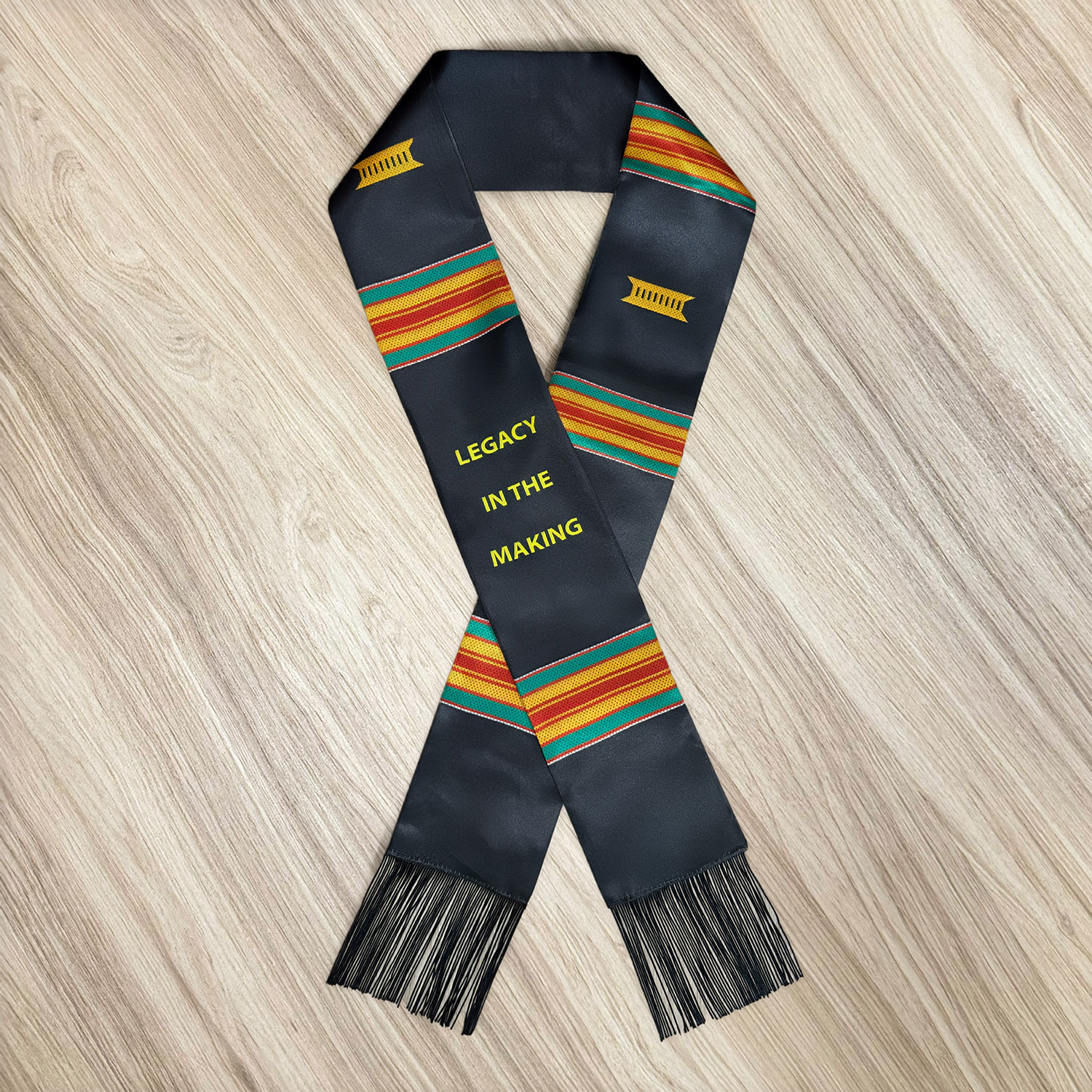
Kente Stole