

George Brown Polytechnic is located on the traditional territory of the Mississaugas of the Credit First Nation and other Indigenous peoples who have lived here over time. We are grateful to share this land as treaty people who learn, work and live in the community with each other.
Interdisciplinary Design Strategy
(Postgraduate) at the Institute Without Boundaries (G414)

Program Details
- Program Code: G414
- Credential: Ontario College Graduate Certificate
- Duration: 9 months
- Method of Study: Full-time
- Starting Months: September
- Domestic Tuition: $13,208.00 *
Program Availability
| Semester | Domestic | International |
|---|---|---|
| Fall 2021 | Closed | Closed |
| Winter 2022 | Not Available | Not Available |
| Spring 2022 | Not Available | Not Available |
- PGWP Eligible: No
- CIP Code: N/A
Program Description
Program Overview
Each September, a small group of students begin a nine-month program in Interdisciplinary Design Strategy at the Institute without Boundaries where they work as a team to research, design and realize a real-world project.
Full Description
Each September, a small group of students begin a nine-month graduate certificate program in Interdisciplinary Design Strategy at the Institute without Boundaries (IwB), where they work as a team to research, design and realize a real-world project. Initiated in 2003, this program delves into the methods and practices of design research, strategy and social innovation. It is a unique educational experience offered by George Brown College in partnership with leading designers and industry.
Transform the world
Our aim is to produce a new breed of designer who can articulate possibilities – one who is, in the words of Buckminster Fuller, a "synthesis of artist, inventor, mechanic, objective economist and evolutionary strategist."
Cross boundaries
This program will accept strong candidates representing different fields – for example, a geographer, an economist, an artist, an architect, a journalist and others – all of whom see the potential for design to change the world.
Broaden horizons
Projects at the Institute without Boundaries often involve international travel to collaborate with communities around the world. Some examples of the places we’ve been include Matapalo (Costa Rica), Lota (Chile), Milan (Italy), Dublin (Ireland), New York City and Chicago. Students are responsible for some additional travel expenses for projects like these.
Deal with reality
The first project of the Institute, created by the 2003 and 2004 classes, was Massive Change: The Future of Global Design, which resulted in a book and travelling exhibition. The World House Project, a three-year initiative, looked at housing systems that are globally responsible and locally appropriate. Students and faculty developed housing models for Canada and Costa Rica that are sustainable, intelligent, universal and affordable.
In September 2009, the Institute embarked on a new project: City Systems. The objective was to explore, dissect and re-imagine the complexities of urban life. Over the course of four years, the Institute partnered with the Toronto Community Housing Corporation on a community rejuvenation proposal for Flemingdon Park; the municipality of Lota (Chile) and its citizens on a project about proactive local action following the earthquake in 2010; the City of Markham on a “change lab” for community building and innovation; and Dublin City Council on “Our Dublin,” a civic engagement program to create transparency and clearer communication between city government and the public.
In 2013, the Institute expanded on City Systems with a new five-year initiative: Regional Ecologies, looking at urbanization as a regional phenomenon. In year one, the Institute focused on the three Gateway Cities of Toronto, New York and Chicago. In year two, the IwB began the next chapter of Regional Ecologies, Divided Places, examining regions characterized by sharp differences in wealth, infrastructure and density where virtual and physical segmentation creates stark social, economic and political inequalities. In year three, the IwB explored "Interstitial Zones." These areas are commonly defined as rural, but they are "in-between" sites that can also include suburbs, agricultural zones, industrial hubs and small-scale craft production areas and towns. The Institute partnered with the Kerry County Council to design strategies for rural areas in southwest Ireland.
In 2016-17, the Institute continued its research on Regional Ecologies, focusing on "symbiotic regions" with the challenge to demonstrate how cities can cooperate at a regional scale to better deliver services, attract investment and create more resilient social and physical infrastructure for living regionally. The partner was Waterfront Toronto.
In 2017-18, the IwB worked with Toronto Global, Neptis Foundation and the Institute for Competitiveness and Prosperity to rethink the Toronto Region as a unified economic region and catalyst for attracting investment.
Learn by doing
Students will engage in a full range of creative work necessary for interdisciplinary design strategy, from research and writing to design and production, and will learn everything necessary to realize these outcomes:
- How to ask questions
- How to listen
- How to research
- How to work with images
- How to engage others
- How to communicate ideas
- How to be a leader and allow others to lead
- How to work with others
- How to make mistakes
- How to take risks
- How to throw away good ideas
Join the project
For more information, visit institutewithoutboundaries.com.
Career & Postgraduate Study Opportunities
Your Career
Graduates from Interdisciplinary Design Strategy at the Institute without Boundaries may find employment in a variety of organizations including:
- not-for-profits
- cultural institutions
- government
- private corporations
- private enterprise or consulting service
Our recent graduates have secured employment worldwide in organizations such as Doctors without Borders, Art Gallery of Ontario, IDEO in California, Ministry of Culture (Costa Rica), Frog Design (New York) and Bruce Mau Design.
Educational Pathways
Courses
SEMESTER 1
| Code | Course Name | Prerequisite |
|---|---|---|
| DESN 4003 | Design Project 1: Communications | |
| DESN 4012 | Design Project 2: Product, Systems and Services | |
| DESN 4005 | Design Project 3: Environment | |
| DESN 4007 | Design Issues, History and Theory | |
| DESN 4008 | Integrated Design Process: Tools, Strategies, Methods and Practices | |
| DESN 4009 | Charrettes I | |
| DESN 4010 | Major Project: Preparation |
SEMESTER 2
| Code | Course Name | Prerequisite |
|---|---|---|
| DESN 4021 | Major Project: Development | DESN 4003 and DESN 4005 and DESN 4007 and DESN 4008 and DESN 4009 and DESN 4010 and DESN 4012 |
| DESN 4022 | Major Project: Communication | DESN 4003 and DESN 4005 and DESN 4007 and DESN 4008 and DESN 4009 and DESN 4010 and DESN 4012 |
| DESN 4024 | Charrettes II | DESN 4009 and DESN 4010 and DESN 4008 |
| DESN 4026 | Design Strategies: Professional Practice | DESN 4010 and DESN 4008 |
| DESN 4027 | Integrated Design Process II | DESN 4008 and DESN 4010 |
Course Outline URL
Students who successfully complete the graduate certificate in Interdisciplinary Design Strategy at the Brookfield Sustainability Institute, George Brown College, are eligible to apply for advanced entry into a Master of Arts in Interdisciplinary Design Strategies offered by the Institute of Art, Design + Technology in Dún Laoghaire, Ireland.
Program Learning Outcomes
The graduate has reliably demonstrated the ability to:
- Apply universal and sustainable design principles to complex global problems in order to create intelligent solutions that address environmental, social and economic challenges.
- Manage an Integrated Design Process to deliver human-centred design strategy projects for government, corporations and non-profit organizations.
- Design collaboratively in an interdisciplinary studio environment to complete environmental, communication, product, service and system design projects.
- Apply primary and secondary research methodologies to the design process using a think/make practice model to achieve project outcomes that meet user needs.
- Adhere to the professional practices of a design studio in order to facilitate the success of design teams in achieving project results.
- Participate in a multi-phase design process in order to create a holistic, integrated and realistic design project.
- Liaise and manage the design process to provide solutions for clients including design, documentation, tendering, fabrication and delivery.
- Present research results and design solutions to a diverse audience utilizing effective communication strategies.
Tuition & Fees
Domestic Tuition
$13,208.00 *
Additional Costs
* Amounts listed are the total of tuition, materials (non-refundable), student service and ancillary fees for the first two semesters of programs starting in Fall 2020. Fees are subject to change for programs starting in Fall 2021 and at later dates.
Some specialized programs have higher tuition fees which will be specified on official College invoices.
International Students
Visit the International Fees and Related Costs page for more information.
Financial Assistance
This program is approved for OSAP funding, provided the applicant meets OSAP eligibility criteria.
Admission Requirements
- Diploma or Bachelor's Degree
- Applicant Questionnaire*
- Resumé*
- Digital Portfolio*
- Online Interview**
* Qualified applicants will be invited to complete the online application questionnaire, including links to view or download a resumé and portfolio.
** Following the review of the application questionnaire, resumé, portfolio and letters of reference, qualified applicants may also be invited for an online interview.
Details on these supplementary requirements will be communicated at a later date to qualified applicants, as part of the review process.
English Language Proficiency
Applicants with international transcripts who do not provide English proficiency test results must test at the College level in the George Brown College English assessment to be considered for admission.
Please visit English Proficiency for more details.
Note: This program continues to accept applications until the seats are filled, which is typically July or August before the September start date. Check the program availability page for program status.
International Students
Visit the International Admissions page for more information regarding country specific admission requirements.
How to Apply
Domestic students should apply through Ontario Colleges.
International Students
Visit the How to Apply page for more information on how and when to apply.
International students should apply through the George Brown Polytechnic Online Application System.
Contact Us
Phone: 416-415-5000, ext. 2137
Email: design@georgebrown.ca
Special Projects and Lab Coordinator, School of Design and Institute without Boundaries: Lori Endes, lendes@georgebrown.ca, 416 415-5000 ext. 2029
For more information about George Brown College, you may also call the Contact Centre at 416-415-2000 (TTY 1-877-515-5559) or long distance 1-800-265-2002.
International Students
Contact one of our international recruitment representatives specializing by country of origin by either booking a virtual meeting or submitting an inquiry. For more information visit the International Contact Us page
Visit Our Campus
This program is part of our School of Design, located at our Waterfront Campus, at 3 Lower Jarvis St., Toronto, Ontario, Canada.
The School of Design resides in a new 103,000-square-foot facility in the Daniels Waterfront – City of the Arts development. This state-of-the-art building supports academic programs and industry projects with features such as:
- virtual and augmented reality lab
- usability and testing lab
- future ways of living lab
- peer tutor lab
- digital Sandbox
- incubators
- prototyping and workshop spaces
- design and innovation showcase spaces
Come and have your questions answered, learn about the program content and career options, meet your friendly professors and staff, and experience what it is like to be in a George Brown College classroom at one of our information sessions. You can also book a campus tour.
Program Description
Program Overview
Each September, a small group of students begin a nine-month program in Interdisciplinary Design Strategy at the Institute without Boundaries where they work as a team to research, design and realize a real-world project.
Full Description
Each September, a small group of students begin a nine-month graduate certificate program in Interdisciplinary Design Strategy at the Institute without Boundaries (IwB), where they work as a team to research, design and realize a real-world project. Initiated in 2003, this program delves into the methods and practices of design research, strategy and social innovation. It is a unique educational experience offered by George Brown College in partnership with leading designers and industry.
Transform the world
Our aim is to produce a new breed of designer who can articulate possibilities – one who is, in the words of Buckminster Fuller, a "synthesis of artist, inventor, mechanic, objective economist and evolutionary strategist."
Cross boundaries
This program will accept strong candidates representing different fields – for example, a geographer, an economist, an artist, an architect, a journalist and others – all of whom see the potential for design to change the world.
Broaden horizons
Projects at the Institute without Boundaries often involve international travel to collaborate with communities around the world. Some examples of the places we’ve been include Matapalo (Costa Rica), Lota (Chile), Milan (Italy), Dublin (Ireland), New York City and Chicago. Students are responsible for some additional travel expenses for projects like these.
Deal with reality
The first project of the Institute, created by the 2003 and 2004 classes, was Massive Change: The Future of Global Design, which resulted in a book and travelling exhibition. The World House Project, a three-year initiative, looked at housing systems that are globally responsible and locally appropriate. Students and faculty developed housing models for Canada and Costa Rica that are sustainable, intelligent, universal and affordable.
In September 2009, the Institute embarked on a new project: City Systems. The objective was to explore, dissect and re-imagine the complexities of urban life. Over the course of four years, the Institute partnered with the Toronto Community Housing Corporation on a community rejuvenation proposal for Flemingdon Park; the municipality of Lota (Chile) and its citizens on a project about proactive local action following the earthquake in 2010; the City of Markham on a “change lab” for community building and innovation; and Dublin City Council on “Our Dublin,” a civic engagement program to create transparency and clearer communication between city government and the public.
In 2013, the Institute expanded on City Systems with a new five-year initiative: Regional Ecologies, looking at urbanization as a regional phenomenon. In year one, the Institute focused on the three Gateway Cities of Toronto, New York and Chicago. In year two, the IwB began the next chapter of Regional Ecologies, Divided Places, examining regions characterized by sharp differences in wealth, infrastructure and density where virtual and physical segmentation creates stark social, economic and political inequalities. In year three, the IwB explored "Interstitial Zones." These areas are commonly defined as rural, but they are "in-between" sites that can also include suburbs, agricultural zones, industrial hubs and small-scale craft production areas and towns. The Institute partnered with the Kerry County Council to design strategies for rural areas in southwest Ireland.
In 2016-17, the Institute continued its research on Regional Ecologies, focusing on "symbiotic regions" with the challenge to demonstrate how cities can cooperate at a regional scale to better deliver services, attract investment and create more resilient social and physical infrastructure for living regionally. The partner was Waterfront Toronto.
In 2017-18, the IwB worked with Toronto Global, Neptis Foundation and the Institute for Competitiveness and Prosperity to rethink the Toronto Region as a unified economic region and catalyst for attracting investment.
Learn by doing
Students will engage in a full range of creative work necessary for interdisciplinary design strategy, from research and writing to design and production, and will learn everything necessary to realize these outcomes:
- How to ask questions
- How to listen
- How to research
- How to work with images
- How to engage others
- How to communicate ideas
- How to be a leader and allow others to lead
- How to work with others
- How to make mistakes
- How to take risks
- How to throw away good ideas
Join the project
For more information, visit institutewithoutboundaries.com.
Career & Postgraduate Study Opportunities
Your Career
Graduates from Interdisciplinary Design Strategy at the Institute without Boundaries may find employment in a variety of organizations including:
- not-for-profits
- cultural institutions
- government
- private corporations
- private enterprise or consulting service
Our recent graduates have secured employment worldwide in organizations such as Doctors without Borders, Art Gallery of Ontario, IDEO in California, Ministry of Culture (Costa Rica), Frog Design (New York) and Bruce Mau Design.
Educational Pathways
Courses
SEMESTER 1
| Code | Course Name | Prerequisite |
|---|---|---|
| DESN 4003 | Design Project 1: Communications | |
| DESN 4012 | Design Project 2: Product, Systems and Services | |
| DESN 4005 | Design Project 3: Environment | |
| DESN 4007 | Design Issues, History and Theory | |
| DESN 4008 | Integrated Design Process: Tools, Strategies, Methods and Practices | |
| DESN 4009 | Charrettes I | |
| DESN 4010 | Major Project: Preparation |
SEMESTER 2
| Code | Course Name | Prerequisite |
|---|---|---|
| DESN 4021 | Major Project: Development | DESN 4003 and DESN 4005 and DESN 4007 and DESN 4008 and DESN 4009 and DESN 4010 and DESN 4012 |
| DESN 4022 | Major Project: Communication | DESN 4003 and DESN 4005 and DESN 4007 and DESN 4008 and DESN 4009 and DESN 4010 and DESN 4012 |
| DESN 4024 | Charrettes II | DESN 4009 and DESN 4010 and DESN 4008 |
| DESN 4026 | Design Strategies: Professional Practice | DESN 4010 and DESN 4008 |
| DESN 4027 | Integrated Design Process II | DESN 4008 and DESN 4010 |
Course Outline URL
Students who successfully complete the graduate certificate in Interdisciplinary Design Strategy at the Brookfield Sustainability Institute, George Brown College, are eligible to apply for advanced entry into a Master of Arts in Interdisciplinary Design Strategies offered by the Institute of Art, Design + Technology in Dún Laoghaire, Ireland.
Tuition & Fees
Domestic Tuition
$13,208.00 *
Additional Costs
* Amounts listed are the total of tuition, materials (non-refundable), student service and ancillary fees for the first two semesters of programs starting in Fall 2020. Fees are subject to change for programs starting in Fall 2021 and at later dates.
Some specialized programs have higher tuition fees which will be specified on official College invoices.
International Students
Visit the International Fees and Related Costs page for more information.
Financial Assistance
This program is approved for OSAP funding, provided the applicant meets OSAP eligibility criteria.
Admission Requirements
- Diploma or Bachelor's Degree
- Applicant Questionnaire*
- Resumé*
- Digital Portfolio*
- Online Interview**
* Qualified applicants will be invited to complete the online application questionnaire, including links to view or download a resumé and portfolio.
** Following the review of the application questionnaire, resumé, portfolio and letters of reference, qualified applicants may also be invited for an online interview.
Details on these supplementary requirements will be communicated at a later date to qualified applicants, as part of the review process.
English Language Proficiency
Applicants with international transcripts who do not provide English proficiency test results must test at the College level in the George Brown College English assessment to be considered for admission.
Please visit English Proficiency for more details.
Note: This program continues to accept applications until the seats are filled, which is typically July or August before the September start date. Check the program availability page for program status.
International Students
Visit the International Admissions page for more information regarding country specific admission requirements.
How to Apply
Domestic students should apply through Ontario Colleges.
International Students
Visit the How to Apply page for more information on how and when to apply.
International students should apply through the George Brown Polytechnic Online Application System.
Program Learning Outcomes
The graduate has reliably demonstrated the ability to:
- Apply universal and sustainable design principles to complex global problems in order to create intelligent solutions that address environmental, social and economic challenges.
- Manage an Integrated Design Process to deliver human-centred design strategy projects for government, corporations and non-profit organizations.
- Design collaboratively in an interdisciplinary studio environment to complete environmental, communication, product, service and system design projects.
- Apply primary and secondary research methodologies to the design process using a think/make practice model to achieve project outcomes that meet user needs.
- Adhere to the professional practices of a design studio in order to facilitate the success of design teams in achieving project results.
- Participate in a multi-phase design process in order to create a holistic, integrated and realistic design project.
- Liaise and manage the design process to provide solutions for clients including design, documentation, tendering, fabrication and delivery.
- Present research results and design solutions to a diverse audience utilizing effective communication strategies.
Contact Us
Phone: 416-415-5000, ext. 2137
Email: design@georgebrown.ca
Special Projects and Lab Coordinator, School of Design and Institute without Boundaries: Lori Endes, lendes@georgebrown.ca, 416 415-5000 ext. 2029
For more information about George Brown College, you may also call the Contact Centre at 416-415-2000 (TTY 1-877-515-5559) or long distance 1-800-265-2002.
International Students
Contact one of our international recruitment representatives specializing by country of origin by either booking a virtual meeting or submitting an inquiry. For more information visit the International Contact Us page
Visit Our Campus
This program is part of our School of Design, located at our Waterfront Campus, at 3 Lower Jarvis St., Toronto, Ontario, Canada.
The School of Design resides in a new 103,000-square-foot facility in the Daniels Waterfront – City of the Arts development. This state-of-the-art building supports academic programs and industry projects with features such as:
- virtual and augmented reality lab
- usability and testing lab
- future ways of living lab
- peer tutor lab
- digital Sandbox
- incubators
- prototyping and workshop spaces
- design and innovation showcase spaces
Come and have your questions answered, learn about the program content and career options, meet your friendly professors and staff, and experience what it is like to be in a George Brown College classroom at one of our information sessions. You can also book a campus tour.

Visit Waterfront Campus
Book campus tourVisit
Our Virtual Tour showcases the following areas:
- Campus Facilities
- Student Services
- Applied Learning Environments
- Labs & Classrooms
Interdisciplinary Design Strategy
(Postgraduate) at the Institute Without Boundaries (G414)
Program Details
- Program Code: G414
- Credential: Ontario College Graduate Certificate
- Duration: 9 months
- Method of Study: Full-time
- Starting Months: September
- Domestic Tuition: $13,164.00 *
Program Availability
| Semester | Domestic | International |
|---|---|---|
| Fall 2020 | Closed | Closed |
| Winter 2021 | Not Available | Not Available |
| Spring 2021 | Not Available | Not Available |
- PGWP Eligible: No
- CIP Code: N/A
Program Description
Program Overview
Each September, a small group of students begin a nine-month program in Interdisciplinary Design Strategy at the Institute without Boundaries where they work as a team to research, design and realize a real-world project.
Full Description
Each September, a small group of students begin a nine-month graduate certificate program in Interdisciplinary Design Strategy at the Institute without Boundaries (IwB), where they work as a team to research, design and realize a real-world project. Initiated in 2003, this program delves into the methods and practices of design research, strategy and social innovation. It is a unique educational experience offered by George Brown College in partnership with leading designers and industry.
Transform the world
Our aim is to produce a new breed of designer who can articulate possibilities – one who is, in the words of Buckminster Fuller, a "synthesis of artist, inventor, mechanic, objective economist and evolutionary strategist."
Cross boundaries
This program will accept strong candidates representing different fields – for example, a geographer, an economist, an artist, an architect, a journalist and others – all of whom see the potential for design to change the world.
Broaden horizons
Projects at the Institute without Boundaries often involve international travel to collaborate with communities around the world. Some examples of the places we’ve been include Matapalo (Costa Rica), Lota (Chile), Milan (Italy), Dublin (Ireland), New York City and Chicago. Students are responsible for some additional travel expenses for projects like these.
Deal with reality
The first project of the Institute, created by the 2003 and 2004 classes, was Massive Change: The Future of Global Design, which resulted in a book and travelling exhibition. The World House Project, a three-year initiative, looked at housing systems that are globally responsible and locally appropriate. Students and faculty developed housing models for Canada and Costa Rica that are sustainable, intelligent, universal and affordable.
In September 2009, the Institute embarked on a new project: City Systems. The objective was to explore, dissect and re-imagine the complexities of urban life. Over the course of four years, the Institute partnered with the Toronto Community Housing Corporation on a community rejuvenation proposal for Flemingdon Park; the municipality of Lota (Chile) and its citizens on a project about proactive local action following the earthquake in 2010; the City of Markham on a “change lab” for community building and innovation; and Dublin City Council on “Our Dublin,” a civic engagement program to create transparency and clearer communication between city government and the public.
In 2013, the Institute expanded on City Systems with a new five-year initiative: Regional Ecologies, looking at urbanization as a regional phenomenon. In year one, the Institute focused on the three Gateway Cities of Toronto, New York and Chicago. In year two, the IwB began the next chapter of Regional Ecologies, Divided Places, examining regions characterized by sharp differences in wealth, infrastructure and density where virtual and physical segmentation creates stark social, economic and political inequalities. In year three, the IwB explored ‘Interstitial Zones.’ These areas are commonly defined as rural, but they are ‘in-between’ sites that can also include suburbs, agricultural zones, industrial hubs and small-scale craft production areas and towns. The Institute partnered with the Kerry County Council to design strategies for rural areas in southwest Ireland.
In 2016-17, the Institute continued its research on Regional Ecologies, focusing on 'symbiotic regions' with the challenge to demonstrate how cities can cooperate at a regional scale to better deliver services, attract investment and create more resilient social and physical infrastructure for living regionally. The partner was Waterfront Toronto.
In 2017-18, the IwB worked with Toronto Global, Neptis Foundation, and the Institute for Competitiveness and Prosperity to rethink the Toronto Region as a unified economic region and catalyst for attracting investment.
Learn by doing
Students will engage in a full range of creative work necessary for interdisciplinary design strategy, from research and writing to design and production, and will learn everything necessary to realize these outcomes:
- How to ask questions
- How to listen
- How to research
- How to work with images
- How to engage others
- How to communicate ideas
- How to be a leader and allow others to lead
- How to work with others
- How to make mistakes
- How to take risks
- How to throw away good ideas
Join the project
For more information, visit institutewithoutboundaries.com.
Career & Postgraduate Study Opportunities
Your Career
Graduates from Interdisciplinary Design Strategy at the Institute without Boundaries may find employment in a variety of organizations including:
- Not-for-profits
- Cultural institutions
- Government
- Private corporations
- Private enterprise or consulting service
Our recent graduates have secured employment worldwide in organizations such as Doctors without Borders, Art Gallery of Ontario, IDEO in California, Ministry of Culture (Costa Rica), Frog Design (New York) and Bruce Mau Design.
Educational Pathways
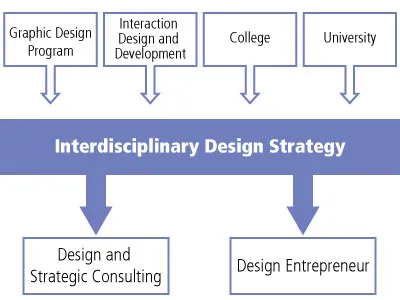
Courses
SEMESTER 1
| Code | Course Name | Prerequisite |
|---|---|---|
| DESN 4003 | Design Project 1: Communications | |
| DESN 4012 | Design Project 2: Product, Systems and Services | |
| DESN 4005 | Design Project 3: Environment | |
| DESN 4007 | Design Issues, History and Theory | |
| DESN 4008 | Integrated Design Process: Tools, Strategies, Methods and Practices | |
| DESN 4009 | Charrettes I | |
| DESN 4010 | Major Project: Preparation |
SEMESTER 2
| Code | Course Name | Prerequisite |
|---|---|---|
| DESN 4021 | Major Project: Development | DESN 4003 and DESN 4005 and DESN 4007 and DESN 4008 and DESN 4009 and DESN 4010 and DESN 4012 |
| DESN 4022 | Major Project: Communication | DESN 4003 and DESN 4005 and DESN 4007 and DESN 4008 and DESN 4009 and DESN 4010 and DESN 4012 |
| DESN 4024 | Charrettes II | DESN 4009 and DESN 4010 and DESN 4008 |
| DESN 4026 | Design Strategies: Professional Practice | DESN 4010 and DESN 4008 |
| DESN 4027 | Integrated Design Process II | DESN 4008 and DESN 4010 |
Course Outline URL
Students who successfully complete the graduate certificate in Interdisciplinary Design Strategy at the Brookfield Sustainability Institute, George Brown College, are eligible to apply for advanced entry into a Master of Arts in Interdisciplinary Design Strategies offered by the Institute of Art, Design + Technology in Dún Laoghaire, Ireland.
Program Learning Outcomes
The graduate has reliably demonstrated the ability to:
- Apply universal and sustainable design principles to complex global problems in order to create intelligent solutions that address environmental, social and economic challenges.
- Manage an Integrated Design Process to deliver human-centred design strategy projects for government, corporations and non-profit organizations.
- Design collaboratively in an interdisciplinary studio environment to complete environmental, communication, product, service and system design projects.
- Apply primary and secondary research methodologies to the design process using a think/make practice model to achieve project outcomes that meet user needs.
- Adhere to the professional practices of a design studio in order to facilitate the success of design teams in achieving project results.
- Participate in a multi-phase design process in order to create a holistic, integrated, and realistic design project.
- Liaise and manage the design process to provide solutions for clients including design, documentation, tendering, fabrication and delivery.
- Present research results and design solutions to a diverse audience utilizing effective communication strategies.
Tuition & Fees
Domestic Tuition
$13,164.00 *
Additional Costs
* Amounts listed are the total of tuition, materials (non-refundable), student service and ancillary fees for the first two semesters of programs starting in Fall 2019. Fees are subject to change for programs starting in Fall 2020 and at later dates.
International students: Visit the International Fees and Related Costs page for more information. Please note that International student tuition is approximately $26,157.
Some specialized programs have higher tuition fees which will be specified on official College invoices.
International Students
Visit the International Fees and Related Costs page for more information.
Financial Assistance
This program is approved for OSAP funding, provided the applicant meets OSAP eligibility criteria.
Admission Requirements
- Diploma or Bachelor's Degree
- Applicant Questionnaire*
- Resume*
- Digital Portfolio*
- Two letters of reference (one academic and one professional)**
- Online Interview***
* Qualified applicants will be invited to complete the online application questionnaire, including links to view or download a resume and portfolio.
** Qualified applicants will also be invited to provide two letters of reference, to be submitted directly to the School of Design by the referees.
*** Following the review of the application questionnaire, resume, portfolio and letters of reference, qualified applicants may also be invited for an online interview.
Details on these supplementary requirements will be communicated at a later date to qualified applicants, as part of the review process.
English Language Proficiency
Applicants with international transcripts who do not provide English proficiency test results must test at the College level in the George Brown College English assessment to be considered for admission.
Please visit georgebrown.ca/englishproficiency for more details.
International (Visa) Students
Visit the International Admissions page for more information.
Note: This program continues to accept applications until the seats are filled, which is typically July or August before the September start date. Check the program availability page for program status.
International Students
Visit the International Admissions page for more information regarding country specific admission requirements.
How to Apply
Domestic students should apply through Ontario Colleges
International Students
Visit the How to Apply page for more information on how and when to apply.
International students should apply through the George Brown Polytechnic Online Application System.
Contact Us
Phone: 416-415-5000, ext. 2137
Email: design@georgebrown.ca
Special Projects and Lab Coordinator, School of Design and Institute without Boundaries: Lori Endes, lendes@georgebrown.ca, 416 415-5000 ext. 2029
For more information about George Brown College, you may also call the Contact Centre at 416-415-2000 (TTY 1-877-515-5559) or long distance 1-800-265-2002.
International Students
Contact one of our international recruitment representatives specializing by country of origin by either booking a virtual meeting or submitting an inquiry. For more information visit the International Contact Us page
Visit Our Campus
This program is part of our School of Design, located at our Waterfront Campus, at 3 Lower Jarvis St., Toronto, Ontario, Canada.
The School of Design resides in a new 103,000-square-foot facility in the Daniels Waterfront – City of the Arts development. This state-of-the-art building supports academic programs and industry projects with features such as:
- Virtual and augmented reality lab
- Usability and testing lab
- Future Ways of Living lab
- Peer tutor lab
- Digital Sandbox
- Incubators
- Prototyping and workshop spaces
- Design and innovation showcase spaces
Come and have your questions answered, learn about the program content and career options, meet your friendly professors and staff, and experience what it is like to be in a George Brown College classroom at one of our information sessions. You can also book a campus tour.
Program Description
Program Overview
Each September, a small group of students begin a nine-month program in Interdisciplinary Design Strategy at the Institute without Boundaries where they work as a team to research, design and realize a real-world project.
Full Description
Each September, a small group of students begin a nine-month graduate certificate program in Interdisciplinary Design Strategy at the Institute without Boundaries (IwB), where they work as a team to research, design and realize a real-world project. Initiated in 2003, this program delves into the methods and practices of design research, strategy and social innovation. It is a unique educational experience offered by George Brown College in partnership with leading designers and industry.
Transform the world
Our aim is to produce a new breed of designer who can articulate possibilities – one who is, in the words of Buckminster Fuller, a "synthesis of artist, inventor, mechanic, objective economist and evolutionary strategist."
Cross boundaries
This program will accept strong candidates representing different fields – for example, a geographer, an economist, an artist, an architect, a journalist and others – all of whom see the potential for design to change the world.
Broaden horizons
Projects at the Institute without Boundaries often involve international travel to collaborate with communities around the world. Some examples of the places we’ve been include Matapalo (Costa Rica), Lota (Chile), Milan (Italy), Dublin (Ireland), New York City and Chicago. Students are responsible for some additional travel expenses for projects like these.
Deal with reality
The first project of the Institute, created by the 2003 and 2004 classes, was Massive Change: The Future of Global Design, which resulted in a book and travelling exhibition. The World House Project, a three-year initiative, looked at housing systems that are globally responsible and locally appropriate. Students and faculty developed housing models for Canada and Costa Rica that are sustainable, intelligent, universal and affordable.
In September 2009, the Institute embarked on a new project: City Systems. The objective was to explore, dissect and re-imagine the complexities of urban life. Over the course of four years, the Institute partnered with the Toronto Community Housing Corporation on a community rejuvenation proposal for Flemingdon Park; the municipality of Lota (Chile) and its citizens on a project about proactive local action following the earthquake in 2010; the City of Markham on a “change lab” for community building and innovation; and Dublin City Council on “Our Dublin,” a civic engagement program to create transparency and clearer communication between city government and the public.
In 2013, the Institute expanded on City Systems with a new five-year initiative: Regional Ecologies, looking at urbanization as a regional phenomenon. In year one, the Institute focused on the three Gateway Cities of Toronto, New York and Chicago. In year two, the IwB began the next chapter of Regional Ecologies, Divided Places, examining regions characterized by sharp differences in wealth, infrastructure and density where virtual and physical segmentation creates stark social, economic and political inequalities. In year three, the IwB explored ‘Interstitial Zones.’ These areas are commonly defined as rural, but they are ‘in-between’ sites that can also include suburbs, agricultural zones, industrial hubs and small-scale craft production areas and towns. The Institute partnered with the Kerry County Council to design strategies for rural areas in southwest Ireland.
In 2016-17, the Institute continued its research on Regional Ecologies, focusing on 'symbiotic regions' with the challenge to demonstrate how cities can cooperate at a regional scale to better deliver services, attract investment and create more resilient social and physical infrastructure for living regionally. The partner was Waterfront Toronto.
In 2017-18, the IwB worked with Toronto Global, Neptis Foundation, and the Institute for Competitiveness and Prosperity to rethink the Toronto Region as a unified economic region and catalyst for attracting investment.
Learn by doing
Students will engage in a full range of creative work necessary for interdisciplinary design strategy, from research and writing to design and production, and will learn everything necessary to realize these outcomes:
- How to ask questions
- How to listen
- How to research
- How to work with images
- How to engage others
- How to communicate ideas
- How to be a leader and allow others to lead
- How to work with others
- How to make mistakes
- How to take risks
- How to throw away good ideas
Join the project
For more information, visit institutewithoutboundaries.com.
Career & Postgraduate Study Opportunities
Your Career
Graduates from Interdisciplinary Design Strategy at the Institute without Boundaries may find employment in a variety of organizations including:
- Not-for-profits
- Cultural institutions
- Government
- Private corporations
- Private enterprise or consulting service
Our recent graduates have secured employment worldwide in organizations such as Doctors without Borders, Art Gallery of Ontario, IDEO in California, Ministry of Culture (Costa Rica), Frog Design (New York) and Bruce Mau Design.
Educational Pathways
Courses
SEMESTER 1
| Code | Course Name | Prerequisite |
|---|---|---|
| DESN 4003 | Design Project 1: Communications | |
| DESN 4012 | Design Project 2: Product, Systems and Services | |
| DESN 4005 | Design Project 3: Environment | |
| DESN 4007 | Design Issues, History and Theory | |
| DESN 4008 | Integrated Design Process: Tools, Strategies, Methods and Practices | |
| DESN 4009 | Charrettes I | |
| DESN 4010 | Major Project: Preparation |
SEMESTER 2
| Code | Course Name | Prerequisite |
|---|---|---|
| DESN 4021 | Major Project: Development | DESN 4003 and DESN 4005 and DESN 4007 and DESN 4008 and DESN 4009 and DESN 4010 and DESN 4012 |
| DESN 4022 | Major Project: Communication | DESN 4003 and DESN 4005 and DESN 4007 and DESN 4008 and DESN 4009 and DESN 4010 and DESN 4012 |
| DESN 4024 | Charrettes II | DESN 4009 and DESN 4010 and DESN 4008 |
| DESN 4026 | Design Strategies: Professional Practice | DESN 4010 and DESN 4008 |
| DESN 4027 | Integrated Design Process II | DESN 4008 and DESN 4010 |
Course Outline URL
Students who successfully complete the graduate certificate in Interdisciplinary Design Strategy at the Brookfield Sustainability Institute, George Brown College, are eligible to apply for advanced entry into a Master of Arts in Interdisciplinary Design Strategies offered by the Institute of Art, Design + Technology in Dún Laoghaire, Ireland.
Tuition & Fees
Domestic Tuition
$13,164.00 *
Additional Costs
* Amounts listed are the total of tuition, materials (non-refundable), student service and ancillary fees for the first two semesters of programs starting in Fall 2019. Fees are subject to change for programs starting in Fall 2020 and at later dates.
International students: Visit the International Fees and Related Costs page for more information. Please note that International student tuition is approximately $26,157.
Some specialized programs have higher tuition fees which will be specified on official College invoices.
International Students
Visit the International Fees and Related Costs page for more information.
Financial Assistance
This program is approved for OSAP funding, provided the applicant meets OSAP eligibility criteria.
Admission Requirements
- Diploma or Bachelor's Degree
- Applicant Questionnaire*
- Resume*
- Digital Portfolio*
- Two letters of reference (one academic and one professional)**
- Online Interview***
* Qualified applicants will be invited to complete the online application questionnaire, including links to view or download a resume and portfolio.
** Qualified applicants will also be invited to provide two letters of reference, to be submitted directly to the School of Design by the referees.
*** Following the review of the application questionnaire, resume, portfolio and letters of reference, qualified applicants may also be invited for an online interview.
Details on these supplementary requirements will be communicated at a later date to qualified applicants, as part of the review process.
English Language Proficiency
Applicants with international transcripts who do not provide English proficiency test results must test at the College level in the George Brown College English assessment to be considered for admission.
Please visit georgebrown.ca/englishproficiency for more details.
International (Visa) Students
Visit the International Admissions page for more information.
Note: This program continues to accept applications until the seats are filled, which is typically July or August before the September start date. Check the program availability page for program status.
International Students
Visit the International Admissions page for more information regarding country specific admission requirements.
How to Apply
Domestic students should apply through Ontario Colleges
International Students
Visit the How to Apply page for more information on how and when to apply.
International students should apply through the George Brown Polytechnic Online Application System.
Program Learning Outcomes
The graduate has reliably demonstrated the ability to:
- Apply universal and sustainable design principles to complex global problems in order to create intelligent solutions that address environmental, social and economic challenges.
- Manage an Integrated Design Process to deliver human-centred design strategy projects for government, corporations and non-profit organizations.
- Design collaboratively in an interdisciplinary studio environment to complete environmental, communication, product, service and system design projects.
- Apply primary and secondary research methodologies to the design process using a think/make practice model to achieve project outcomes that meet user needs.
- Adhere to the professional practices of a design studio in order to facilitate the success of design teams in achieving project results.
- Participate in a multi-phase design process in order to create a holistic, integrated, and realistic design project.
- Liaise and manage the design process to provide solutions for clients including design, documentation, tendering, fabrication and delivery.
- Present research results and design solutions to a diverse audience utilizing effective communication strategies.
Contact Us
Phone: 416-415-5000, ext. 2137
Email: design@georgebrown.ca
Special Projects and Lab Coordinator, School of Design and Institute without Boundaries: Lori Endes, lendes@georgebrown.ca, 416 415-5000 ext. 2029
For more information about George Brown College, you may also call the Contact Centre at 416-415-2000 (TTY 1-877-515-5559) or long distance 1-800-265-2002.
International Students
Contact one of our international recruitment representatives specializing by country of origin by either booking a virtual meeting or submitting an inquiry. For more information visit the International Contact Us page
Visit Our Campus
This program is part of our School of Design, located at our Waterfront Campus, at 3 Lower Jarvis St., Toronto, Ontario, Canada.
The School of Design resides in a new 103,000-square-foot facility in the Daniels Waterfront – City of the Arts development. This state-of-the-art building supports academic programs and industry projects with features such as:
- Virtual and augmented reality lab
- Usability and testing lab
- Future Ways of Living lab
- Peer tutor lab
- Digital Sandbox
- Incubators
- Prototyping and workshop spaces
- Design and innovation showcase spaces
Come and have your questions answered, learn about the program content and career options, meet your friendly professors and staff, and experience what it is like to be in a George Brown College classroom at one of our information sessions. You can also book a campus tour.
Visit Waterfront Campus
Book campus tourVisit
Our Virtual Tour showcases the following areas:
- Campus Facilities
- Student Services
- Applied Learning Environments
- Labs & Classrooms