
George Brown Polytechnic is located on the traditional territory of the Mississaugas of the Credit First Nation and other Indigenous peoples who have lived here over time. We are grateful to share this land as treaty people who learn, work and live in the community with each other.
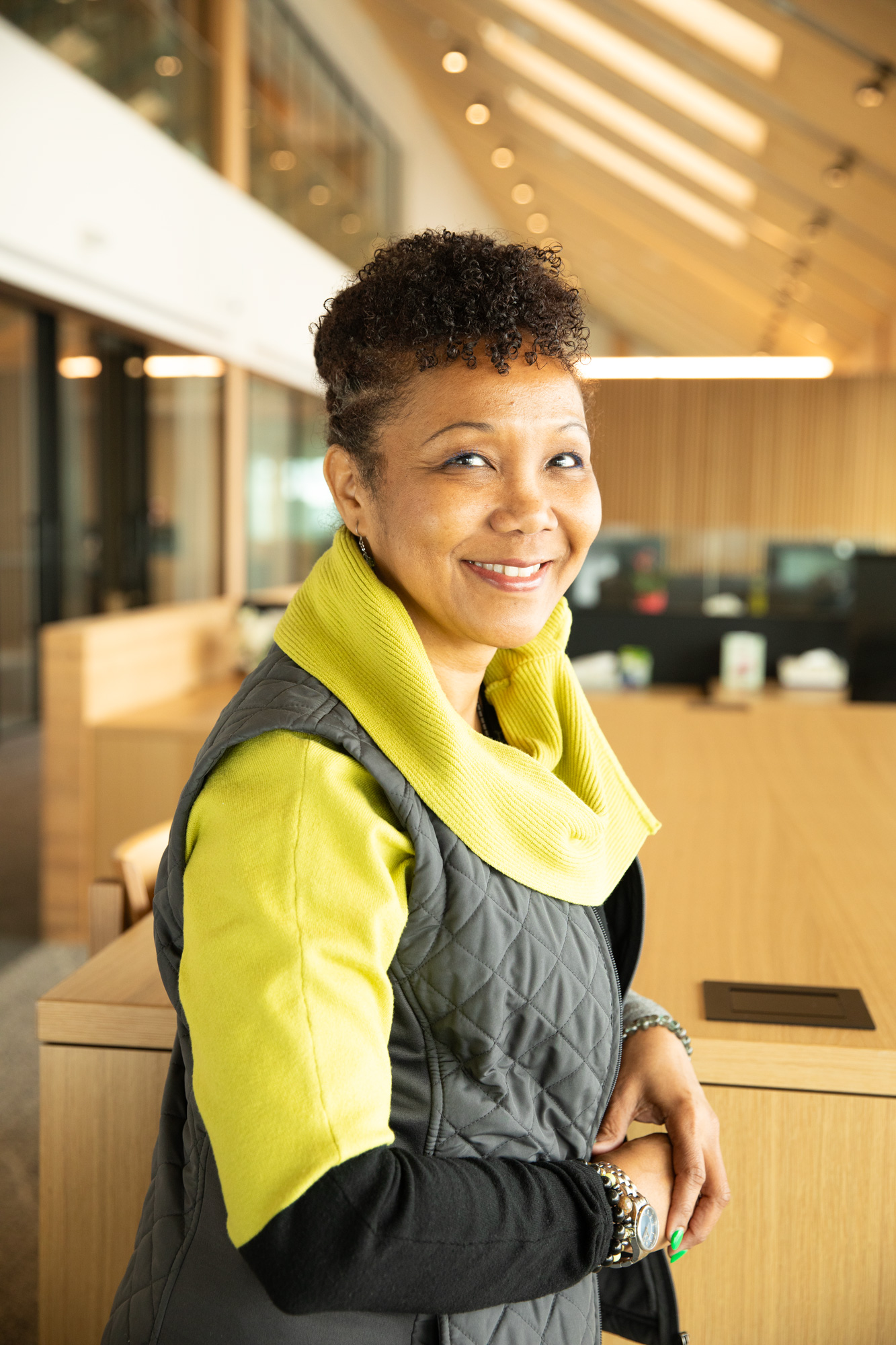
When you speak with Andrea Bryan, you don’t just hear about community engagement—you feel it. Her energy crackles, her passion fills the room, and within minutes, it becomes clear why colleagues describe her as a connector, a bridge‑builder, and a catalyst for change. “I love the work,” she says, radiating the kind of enthusiasm that makes you want to follow her into any project. “It’s exciting. It’s meaningful. And it’s all about people.”
As George Brown Polytechnic celebrates Black Futures Month, Andrea’s story offers a vivid look at what it means to create community, foster access, and shape futures with intention and heart.
A role built on connection
Andrea joined George Brown in June 2025 as the Strategic Advisor for Community Engagement and Partnerships, a role she describes as deeply relational and rooted in collaboration.
“I’m coming in from a community perspective to serve as a connector,” she explains. “What I do is bring people, departments, opportunities, and external partners together.”
Her work focuses on mapping and understanding the breadth of engagement happening across the institution—a task made more complex by how decentralized the work has been in the past. She and colleague Ranjit Singh are building an inventory of community partnerships, identifying gaps, spotting opportunities, and laying the foundation for a comprehensive engagement ecosystem.
“The goal,” Andrea says, “is to create a clearer picture of what’s happening, how far we’ve reached, where the gaps are, and where the opportunities lie.”
A career rooted in service and systemic change
With more than two decades across the nonprofit, post-secondary, and community development sectors, Andrea has built a career centred on access, equity, and empowerment.
Since high school, she says, she has believed that “the systems did not prepare young people for the real world.” That conviction drove her work with the Toronto District School Board, the Ministry of Citizenship, Ontario Anti-RacismSecretariat, Tropicana Community Services, United Way, and Centennial College. In every role, the theme remained consistent: connecting people to opportunities they might otherwise miss.
“I’ve seen firsthand how important access to information is,” she says. “You can’t change the trajectory of your life if you don’t have access to education and training.”
Whether supporting youth entrepreneurship, building community-driven safety initiatives, or co-developing a Black Early Childhood Education program, Andrea has championed solutions informed by the people most affected.
“Sometimes we forget that young people still need support,” she reflects. “They’re tech savvy, but that doesn’t mean they automatically know how to use those tools from a business perspective. They grow when we create ecosystems where they can learn from each other—and from us.”
Creating pathways, co-creating futures
Andrea’s work at George Brown is already opening new doors and possibilities for members of our community.
But for young people whose educational journeys have been interrupted or who face barriers to accessing post-secondary opportunities, she is especially excited to build new programs that help them rebuild momentum—whether through bridging programs, wraparound supports, or entry points that honour their lived experiences.
“When we create environments that recognize their realities, and we meet them where they’re at, together we can create pathways for access and success.”
What Black Futures means to her
When Andrea thinks about Black Futures Month, she is immediately reminded of the Sankofa bird—a symbol of looking back in order to move forward.
“I think about fetching our history, using that to ground us so we can move forward,” she says. “Black Futures Month is the time to pause, reflect, re-engage, unlearn, and relearn.”
She emphasizes that Black Futures work extends beyond February—something she sees modelled throughout George Brown.
“It’s important to celebrate, to acknowledge the wins—big and small. Despite the issues around us, we need moments of joy, learning, and laughter.”
Surprised and moved by the community
When asked about her most surprising experience since joining George Brown, Andrea doesn’t hesitate.
“How welcoming people are,” she says warmly. “Someone I met months ago will still ask about my ankle injury. People are genuinely kind and collaborative. That’s heartfelt.”
She has also been moved by how highly external partners speak of the institution.
“One organization said, ‘You’re the best kept secret.’ They told me working with George Brown is collaborative and easy. That speaks volumes.”
Andrea credits this to what she calls George Brown’s “collaborative energy,” which she felt from her first day on campus.
“Everybody’s interested in making a difference,” she says. “Everybody’s interested in asking: How can we work together?”
Looking ahead
As she continues developing frameworks, partnerships, and pathways, Andrea is driven by a clear long-term vision: a George Brown that knows its impact, understands its reach, and supports communities through responsive, co-created initiatives.
“I feel like I’ve just barely touched the surface,” she says with a laugh. “There’s so much more to learn. And that’s exciting.”
This Black Futures Month, we celebrate Andrea not just for the work she does, but for the spirit she brings—a spirit of connection, collaboration, and community transformation.