

George Brown Polytechnic is located on the traditional territory of the Mississaugas of the Credit First Nation and other Indigenous peoples who have lived here over time. We are grateful to share this land as treaty people who learn, work and live in the community with each other.
George Brown Polytechnic developed Strategy 2030 with input from people across the institution and beyond. Students, employees, alumni, and industry and community partners helped us identify opportunities and challenges that should guide our next steps.
We considered their perspectives alongside lessons from Strategy 2026, changes in post-secondary education, and work on George Brown's Academic Plan. Together, these inputs helped shape the strategy's three priorities and its focus on measurable progress.
Listening To Our Community
Between March and July 2026, the George Brown community was engaged in Strategy 2030 in the following ways:
750+
participant engagements helped shape Strategy 2030
584
respondents took part in five surveys
7
focus groups recorded 134 participant instances
2
employee listening sessions
11
one-on-one discussions with senior George Brown leaders
14
interviews with external leaders
- We held validation meetings with multiple employee groups, and a Validation Feedback Form was open to all George Brown employees.
- We held a strategy consultation session with the George Brown Board of Governors in September 2026.
We are grateful to everyone who took the time and effort to engage in the strategic planning process, enabling a stronger, clearer, more pragmatic, and agile Strategy 2030 for the entire GBP community.
What We Heard
Several connected themes emerged across the consultations:
Learning that opens doors
More flexible pathways, career-relevant programs, and opportunities for students to apply what they learn.
More connected experiences
Accessible services, better co-ordination across George Brown, and reciprocal partnerships with industry and communities.
Clear priorities and accountability
A financially sustainable institution, better coordination, and meaningful ways to measure progress.
How Community Feedback Helped Shape Strategy 2030
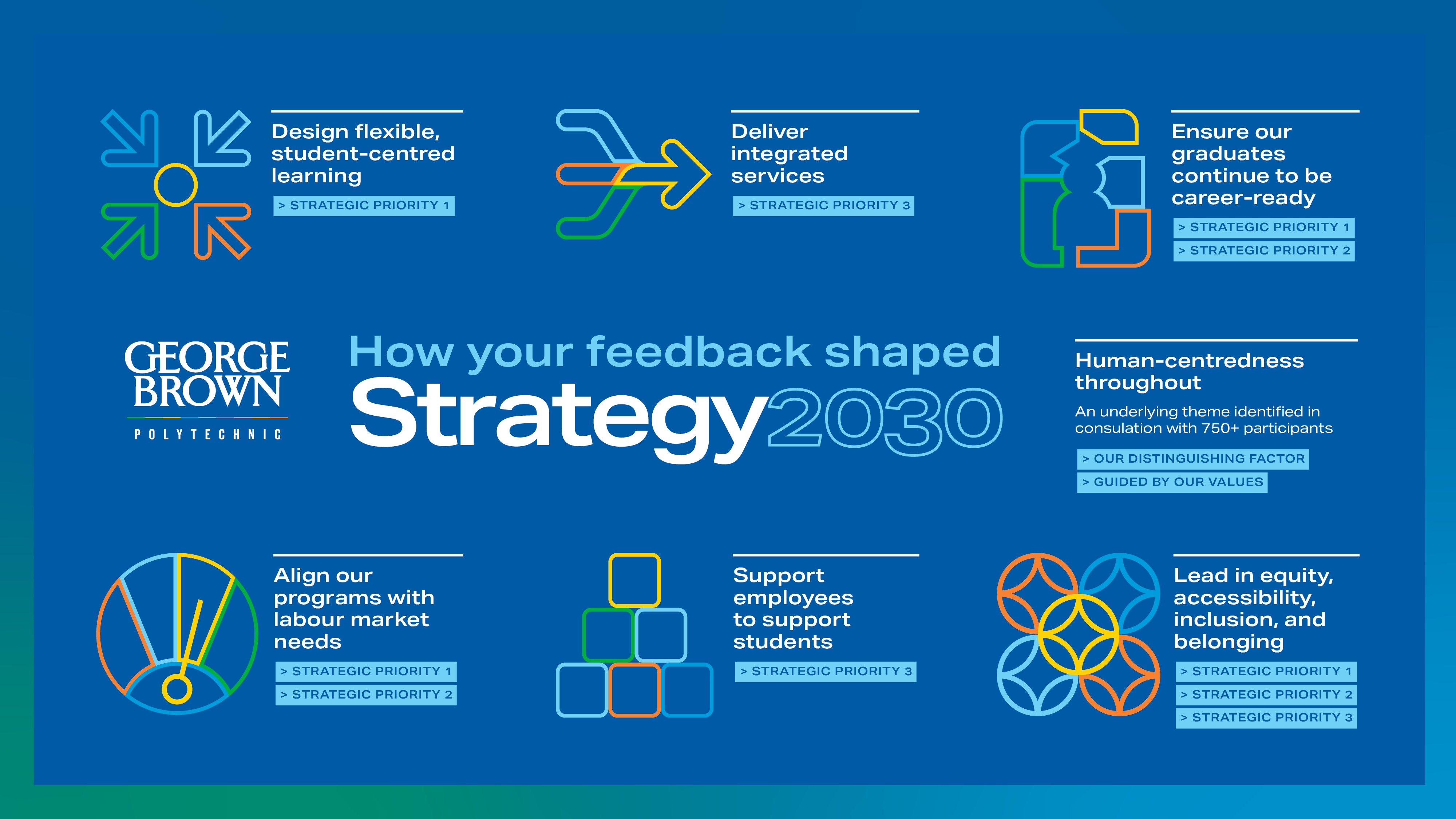
Infographic text
- Design flexible, student-centred learning (Strategic Priority 1)
- Deliver integrated services (Strategic Priority 3)
- Ensure our graduates continue to be career-ready (Strategic Priority 1, Strategic Priority 2)
- Human-centredness throughout: An underlying theme identified in consultation with 750+ participants (Our Distinguishing Factor, Guided by Our Values)
- Align our programs with labour market needs (Strategic Priority 1, Strategic Priority 2)
- Support employees to support students (Strategic Priority 3)
- Lead in equity, accessibility, inclusion, and belonging (Strategic Priority 1, Strategic Priority 2, Strategic Priority 3)
People also called for a strategy that makes clear choices.
They wanted fewer priorities, resources aligned to those priorities, and practical measures to show whether the work is making a difference.
Building on Work Already Underway

Community feedback was an important starting point, but it wasn't the only influence on Strategy 2030. We also drew on existing plans and initiatives across George Brown, including the following:
- Academic Plan
- People Plan
- Indigenous Education Strategy
- Anti-Racism Action Plan
- Information and Technology Strategic Plan, and
- Polytechnic transformation projects.
Together, these inputs helped us connect what we heard from our community with work already happening across the institution. They also helped shape a strategy that brings our priorities together and provides clearer direction for the years ahead.
Looking at the bigger picture

To develop Strategy 2030, we also looked at the changes influencing post-secondary education beyond just George Brown Polytechnic. Our environmental scan examined shifting demographics and enrolment patterns, government policy and funding, the economy, workforce needs, and emerging technologies.
These findings helped us decide where to focus. Changing learner expectations and workforce needs reinforced the importance of flexible learning pathways, career-relevant programs, and applied research. Financial pressures also highlighted the need to make careful decisions about how we use our resources.
We considered how emerging technologies, including artificial intelligence, are changing teaching, learning, and work. We also looked at how stronger partnerships can help us respond to challenges and opportunities beyond campus.
Together with community feedback and our existing institutional plans, this broader perspective helped shape three priorities that reflect both our ambitions and what we can realistically achieve.
How Strategy 2030 Took Shape
- Review and planning | Spring 2026: We looked at Strategy 2026, the changing post-secondary environment, and George Brown's priorities as a polytechnic to prepare for the consultation process.
- Consultation and development | Spring–fall 2026: Input gathered from March through July helped identify shared concerns and opportunities. Those findings informed the direction and priorities of Strategy 2030.
- Validation and finalization | Summer–fall 2026: We gathered further feedback through employee presentations, leadership discussions, and validation sessions throughout the summer and early fall of 2026. Employees also had an opportunity to provide input through a validation form open from July 15 to September 23. The Board of Governors participated in a consultation session on September 25, 2026. Together, these activities helped us refine the strategy's priorities and direction before finalization.
- Implementation | Fall 2026 onward: The focus shifts to putting commitments into practice, aligning plans and resources, and clarifying responsibilities across the institution.
- Progress and reporting | Through 2030: George Brown will track outcomes, share updates, and report on what is working and where changes are needed. That transparency is part of staying accountable to our community.